
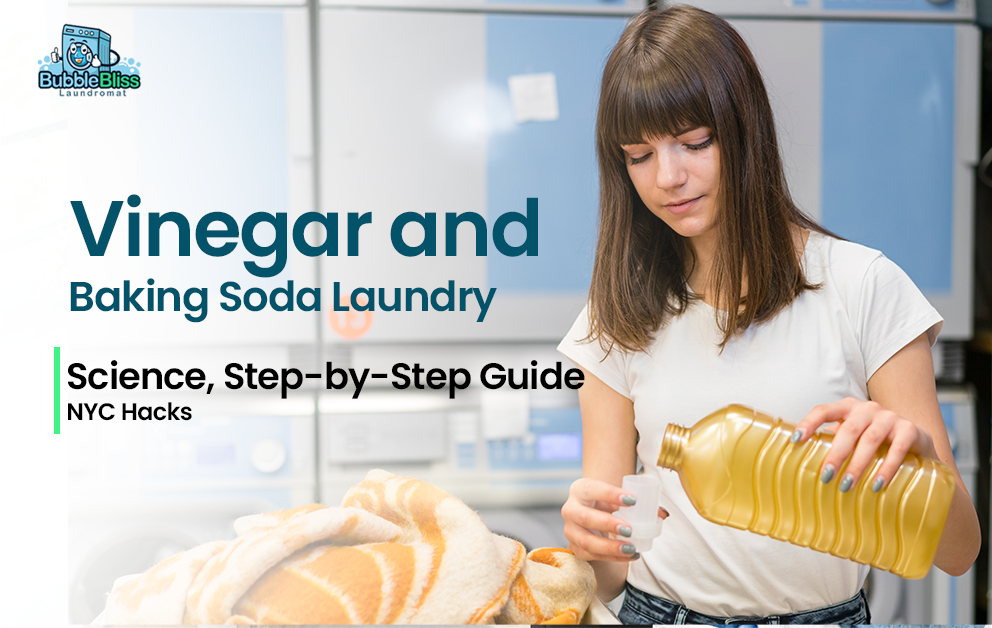
The internet features a widespread obsession with mixing natural laundry additives for enhanced cleaning performance. Vinegar and baking soda laundry care routines frequently recommend combining these household staples into a single cleaning step. However, baking soda and vinegar are exceptional textile care tools only when used separately at different cycle stages. Combining them crAging municipal building iron pipes eates an immediate acid-base neutralization reaction that results in a fizzing paste, neutralizing both substances and accomplishing nothing chemically. Urban NYC living presents unique laundry challenges, including severe hard water mineral scale and heavy detergent buildup left behind by communal coin-operated machines. Baking soda acts as a mild alkaline booster during the main wash cycle at a pH of 8.3, softening hard water and releasing trapped odors. Distilled white vinegar introduces a mild acetic acid rinse at a pH of 2.5 during the final rinse cycle, dissolving mineral scale and stripping away residual surfactant films. Separating these applications protects delicate textile fibers from urban residue accumulation.
The Chemistry of Baking Soda vs. Vinegar in Laundry
To fully understand the Vinegar and baking soda laundry Science you need to keep in mind that, Sodium bicarbonate (NaHCO₃) functions as a mild alkaline compound in aqueous solutions. Acetic acid (CH₃COOH) operates as a weak organic acid derived from fermentation processes. Mixing these two substances simultaneously triggers an acid-base neutralization reaction within the aqueous medium.
This chemical interaction yields sodium acetate (CH₃COONa), water (H₂O), and carbon dioxide gas (CO2). The reaction consumes the active ions of both raw materials. Consequently, simultaneous dosing strips baking soda and vinegar of their individual cleaning potentials. Baking soda loses its alkaline buffering capacity required to neutralize acidic odors and soften hard water. Vinegar loses its acidic capability to dissolve mineral deposits and strip surfactant films. Separating the application across different cycle stages prevents this neutralization failure.
Baking Soda vs. Vinegar in Laundry: When and How to Use Each
Baking soda and vinegar serve distinct, non-overlapping functions when utilized in a laundry routine. Baking soda and vinegar in washing machine cycles must be applied during separate phases to maximize cleaning efficiency without chemical cancellation. Baking soda vs vinegar laundry applications depend entirely on the specific stage of the wash cycle and the target contaminant. Vinegar in laundry cycles functions exclusively as a final-stage additive for fabric rinsing and scale removal.
The Dual-Phase Application Protocol
Baking soda operates during the primary wash cycle to soften water and neutralize acidic compounds. Distilled white vinegar operates during the deep rinse cycle to strip residual detergent films and eliminate static cling. Applying these two agents sequentially rather than simultaneously preserves their individual chemical mechanisms.
Fabric Classification Matrix
| Fabric Category | Baking Soda Application (Wash Cycle) | Vinegar Application (Rinse Cycle) |
| Cotton & Linen | Safe for stain pre-soaking and odor neutralization | Safe for softening and brightener activation |
| Synthetic Blends | Effective for oil breakdown and static reduction | Effective for removing trapped body odors |
| Wool & Silk | Unsafe; alkaline pH damages protein-based fibers | Safe only in highly diluted concentrations |
| Denim | Safe for locking color and neutralizing odors | Safe for fiber relaxation and residue stripping |
Step-by-Step Action Protocol Table
| Step Number | Cycle Phase | Action Protocol | Target Contaminant |
| Step 1 | Main Wash | Add 1/2 cup of baking soda directly into the drum with laundry detergent. | Body oils, fatty acids, and hard water minerals |
| Step 2 | Agitation | Allow the machine to agitate and complete the primary washing phase. | Embedded soil and trapped organic odors |
| Step 3 | Deep Rinse | Pour 1/2 cup of distilled white vinegar into the liquid fabric softener dispenser. | Surfactant film buildup and alkaline residue |
| Step 4 | Final Spin | Complete the final extraction cycle without adding further chemical agents. | Residual acetic scent and excess moisture |
Phase 1- Baking Soda in the Wash Cycle (Alkaline Cleansing)
Baking soda functions as a detergent builder that enhances cleaning efficiency during the primary wash cycle. Sodium bicarbonate elevates water pH to ~ 8.3, boosting surfactant performance and saponifying body lipids.
The generated hydroxide ions increase alkalinity. This alkaline environment helps break down acidic body oils and trapped organic residues on fabrics. Baking soda also binds with hardness ions in the water supply, preventing calcium and magnesium from interfering with surfactant molecules. Consequently, the detergent performs with higher efficiency without requiring extra chemical quantities.
Phase 2: Vinegar in the Rinse Cycle (Acid Souring & Soap Scum Stripping)
Distilled white vinegar functions as a fabric souring agent during the deep rinse cycle to eliminate residual buildup. Vinegar lowers solution pH to ~ 2.5, dissolving insoluble soap scum like calcium stearate and stripping accumulated mineral scale.
This acidic rinsing action neutralizes remaining alkaline detergent residues trapped inside textile weaves. Stripping these residues restores natural fiber absorbency and eliminates static cling. Introducing the acid exclusively during the final rinse prevents interference with the earlier alkaline wash phase.
Step-by-Step Dosing & Application Protocol
Precise measurement and timed introduction ensure optimal fabric care and equipment preservation. Add exactly 1/2 cup of baking soda directly into the washing machine drum with your standard laundry detergent at the start of the wash cycle. Add exactly 1/2 cup of 5% white distilled vinegar into the liquid fabric softener dispenser so it releases automatically during the final rinse cycle. Avoid over-concentrating or directly pouring raw, undiluted vinegar onto internal rubber hoses and gaskets. Continuous exposure to high-concentration acid can degrade rubber components over time.
NYC Apartment Realities: Hard Water, Gasket Risks & Space Constraints
NYC apartment living introduces unique environmental challenges that impact domestic fabric routines. Baking soda and vinegar in washing machine protocols must account for local urban infrastructure realities. Aging municipal building iron pipes contribute $0.4\text{ mg/L}$ iron deposits into residential water supplies. These metallic minerals interact with hard water scale, embedding stubborn discoloration into textile fibers during the wash cycle. Small apartment storage constraints further limit bulk chemical storage, necessitating compact and efficient cleaning solutions. Vinegar in laundry cycles helps manage residual buildup, but communal urban laundry setups require strict procedural discipline to protect equipment and garments.
The Gasket Hazard & NYC Laundromat Friction
Pouring raw vinegar directly onto rubber door seals in high-friction commercial laundromat washers degrades neoprene gaskets over 25 cycles. Commercial washing machines utilize high-friction industrial elastomers to maintain waterproof seals under intense rotational stress. Direct application of undiluted acetic acid onto these neoprene surfaces accelerates polymer breakdown, surface softening, and micro-cracking. Diluting vinegar properly in the designated machine dispenser prevents direct chemical erosion of vulnerable rubber components.
Cost & Comparison: DIY Chemical Washing vs. Bubble Bliss Valet
Outsourcing garment processing to a professional valet service eliminates the labor and equipment risks associated with multi-stage chemical dosing in coin-operated laundromats. Managing DIY baking soda and vinegar cycles requires precise chemical measurement, equipment monitoring, and manual sorting to prevent fabric and gasket degradation. Professional laundry valets utilize automated industrial dosing systems and controlled thermal parameters, reducing overall garment wear and saving significant personal time.
Table 2: Financial Cost Analysis Table
| Operational Expense | DIY Coin Laundromat & Chemical Washing | Bubble Bliss Valet Service |
| Detergent & Additives | USD 15.00 per month (Baking soda, vinegar, surfactant) | Included in service tier |
| Machine Usage Fees | USD 40.00 per month (Coin-operated washers and dryers) | Included in service tier |
| Garment Replacement Risk | High (Potential damage from hard water scale and high heat) | Low (Professional textile handling guarantees) |
| Time Valuation | USD 60.00 per month (Valued at 4 hours of personal labor) | Zero personal time expended |
| Total Monthly Cost | USD 115.00 equivalent | USD 85.00 fixed tier |
Table 3: Processing Timeline Table
| Workflow Stage | DIY Chemical Washing Protocol | Bubble Bliss Valet Service |
| Sorting & Pre-Treatment | 30 minutes (Manual stain check and separation) | 0 minutes (Handled by facility staff) |
| Transport & Waiting | 90 minutes (Travel to facility and cycle monitoring) | 5 minutes (Doorstep pickup and delivery scheduling) |
| Washing & Chemical Dosing | 45 minutes (Manual addition of baking soda in drum) | Automated precision dosing |
| Rinsing & Souring | 30 minutes (Manual addition of vinegar in dispenser) | Automated acid-souring rinse |
| Drying & Finishing | 60 minutes (Risk of radiator or commercial heat distortion) | Controlled moisture extraction and folding |
| Total Time Investment | 255 minutes per week | 5 minutes per week |
Frequently Asked Questions About Vinegar and Baking Soda Laundry
Q1: Can I mix baking soda and vinegar together in the washing machine?
Answer: No. Mixing baking soda and vinegar together causes an immediate acid-base neutralization reaction, producing water, carbon dioxide gas, and sodium acetate salt. This cancels out baking soda’s alkaline cleaning power and vinegar’s acidic soap-stripping ability, leaving an inert liquid that provides zero textile cleaning benefits in your washer.
Q2: Should baking soda go in the wash cycle or rinse cycle?
Answer: Baking soda should always go directly into the washer drum during the main wash cycle. As a mild alkali with a pH of 8.3, it boosts detergent performance, softens hard water, solubilizes body oils, and neutralizes acidic odors before the rinse cycle begins.
Q3: Where do I put vinegar in a washing machine?
Answer: Vinegar should be poured into the fabric softener compartment or added manually at the start of the final rinse cycle. Its acidic pH of 2.5 neutralizes residual wash alkalinity, strips detergent soap scum, and dissolves mineral buildup without coating cotton fibers like commercial softeners.
Q4: Does vinegar damage rubber gaskets in washing machines?
Answer: Undiluted or excessive vinegar can degrade synthetic rubber gaskets, hoses, and door seals over time. To protect washing machine components, use no more than one-half cup of 5% distilled white vinegar diluted into the automatic softener dispenser during the final rinse cycle rather than pouring it raw.
Q5: Is vinegar or baking soda better for removing sweat smells?
Answer: Both work best sequentially. Baking soda neutralizes acidic organic sweat compounds during the main wash cycle. Vinegar then strips the lipid soap scum trapping those odor-causing bacteria during the final rinse cycle. Using both in separate stages guarantees complete odor elimination from workout gear and heavy cotton.
Q6: Can vinegar and baking soda replace regular laundry detergent?
Answer: No. Neither vinegar nor baking soda contains surfactants capable of lifting suspended dirt and emulsifying heavy body oils. They function as cleaning boosters and fabric conditioners. For optimal sanitation, pair them with a high-quality surfactant detergent, using baking soda in wash and vinegar in rinse.
Q7: How does vinegar help with hard water in NYC apartments?
Answer: Aging NYC building pipes often deposit trace iron, calcium, and magnesium onto clothing. Vinegar’s acetic acid acts as a natural chelating agent during the rinse cycle, dissolving hard water mineral scale and preventing white fabrics from turning stiff, scratchy, or yellow over time.
Q8: How often should I use vinegar and baking soda in my laundry?
Answer: You can use baking soda and vinegar every load for towels, gym wear, and bed linens to maintain softness and freshness. For everyday clothing, applying this sequential protocol every two to three wash cycles effectively prevents soap scum accumulation and mineral buildup without stressing sensitive fabrics.
Conclusion: Elevate Your Household Linen & Garment Care
Proper household linen and garment maintenance requires strict adherence to sequential chemical phasing to prevent textile degradation. Never mix baking soda and vinegar simultaneously, as their immediate acid-base neutralization cancels out active cleaning properties. Apply baking soda during the main wash phase at an alkaline pH of 8.3 to boost surfactant efficiency and dissolve body lipids. Introduce distilled white vinegar during the final rinse phase at an acidic pH of 2.5 to dissolve soap scum and strip mineral scale. Avoid drying wet garments on hot steam radiators to prevent thermal distortion and trapped residue. Relying on these scientific souring and sequential dosing protocols ensures plush, clean, and structurally sound textiles.
Effortless professional garment care is now accessible through Bubble Bliss NYC laundry valet services. Our specialized wash-and-fold service handles complex chemical souring, hard water neutralization, and temperature-controlled tumble drying automatically. Directing your laundry operations to our professional facility eliminates the time and risks associated with DIY multi-stage chemical dosing. Customers can easily schedule their convenient doorstep pickup and delivery online to streamline their weekly routines.
Effortless Professional Textile Care: Bubble Bliss NYC Laundry Valet
Effortless professional garment care is now accessible through Bubble Bliss NYC laundry valet services. Our specialized wash-and-fold service handles complex chemical souring, hard water neutralization, and temperature-controlled tumble drying automatically. Directing your laundry operations to our professional facility eliminates the time and risks associated with DIY multi-stage chemical dosing. Customers can easily schedule their convenient doorstep pickup and delivery online to streamline their weekly routines.