
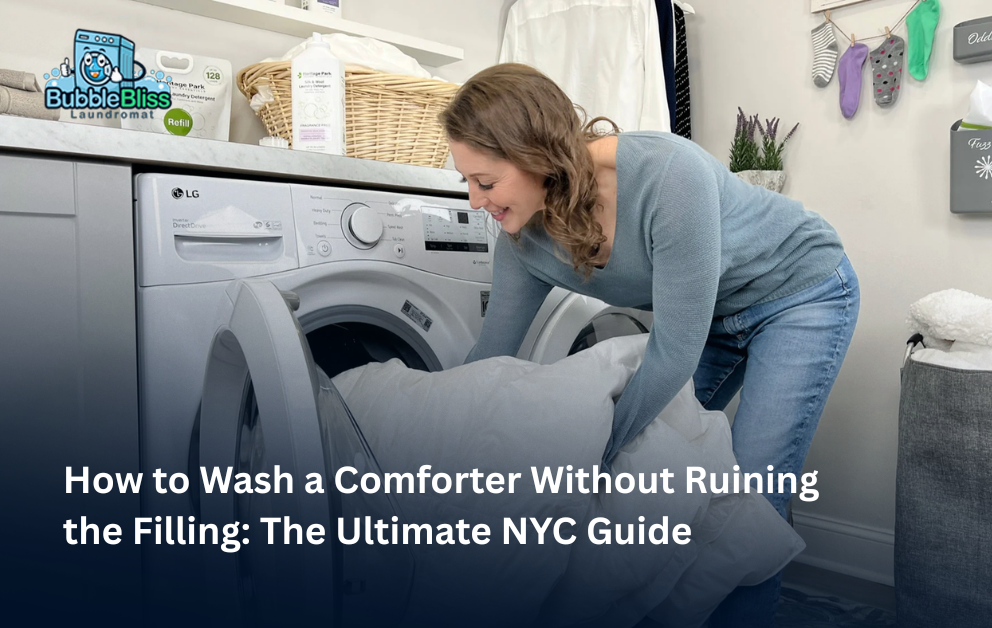
Successful home laundering of a comforter requires a front-load washing machine with a minimum drum capacity of 4.5 cubic feet. Users must utilize low-temperature kinetic agitation settings to protect the structural integrity of natural down clusters and synthetic fibers. So, we will discuss how to wash a comforter without ruining the filling.
The New York City Laundry Challenge
New York City apartments feature severe space constraints. Most residential washing units utilize compact 24-inch wide external frames. These small machines restrict internal drum volumes to a range between 2.2 and 3.5 cubic feet. Cramming a large comforter into these undersized residential machines prevents the bedding from moving freely during the cycle. This restriction leads to imbalanced laundry loads. It also prevents thorough surfactant rinsing.
Understanding the Financial Risk
Washing high-value bedding at home carries a significant financial risk for consumers. A quality down comforter represents a substantial investment ranging from $200 to $800+ in current market value. Improper residential cleaning causes permanent clumping of internal down clusters. Incorrect drying temperatures strip natural protective oils from feather shafts. These laundering errors cause structural damage and force a premature replacement purchase.
Why Capacity and Temperature Matter
You need to understand why capacity and temperature is so important when it comes to washing a comforter without ruining the filling. Large commercial washing drums allow a comforter to tumble without structural compression. This tumbling action provides effective cleaning without creating high mechanical stress. High heat settings and aggressive agitation cycles deform delicate bedding fills. These aggressive parameters permanently reduce the thermal loft of the comforter. A front-load capacity of 4.5 cubic feet ensures sufficient physical clearance for the bedding to open fully. Low-temperature kinetic agitation preserves the integrity of the fiber architecture.
Decoding Bedding Anatomy: Down vs. Down-Alternative Fillings
Natural down comforters consist of organic keratin protein clusters. These clusters require neutral-pH, enzyme-free liquid cleaning agents to preserve their protective lipid coatings. Down-alternative comforters utilize synthetic interlocking polyester fibers. These alternative materials necessitate low-temperature drying and reduced spin cycles to prevent thermal deformation.
Natural Down Clusters
Natural down comprises complex, three-dimensional keratin protein structures. These clusters maintain thermal efficiency through naturally occurring lipid waxes. Harsh alkaline detergents and dry-cleaning solvents like perchloroethylene dissolve these protective coatings. Laboratory testing shows that aggressive chemical exposure strips 37% of these natural waxes per wash cycle. Stripped down clusters lose their resilience and thermal insulation capabilities. Furthermore, organic keratin fibers exhibit high water retention properties. If moisture remains trapped inside the fill for more than 48 hours, the bedding becomes a substrate for Aspergillus niger mold colonization. Safe maintenance requires specialized liquid washes calibrated to a neutral pH range of 7.2–7.6.
Down-Alternative Fibers
Down-alternative comforters utilize manufactured polyester filaments. These synthetic fibers offer high resistance to organic mold contamination. However, synthetic fillings are highly vulnerable to mechanical friction and thermal degradation. Heavy spin parameters subject the interlocking filaments to excessive shear stress. Historical laboratory metrics show that aggressive friction induces a 24–37% loss in elastic recovery. High-heat settings inside dryer drums trigger localized thermal melting of fine polyester strands. This melting causes irreversible fiber matting and structural flat spots. Preserving the loft of synthetic bedding requires low spin speed and low-heat structural drying cycles.
Key Bedding Material Facts Table
| Material Type | Core Filling Structure | Primary Vulnerability | Critical Wash Directive |
| Natural Down / Feather | Keratin protein clusters | Chemical wax stripping & Aspergillus niger mold expansion | Use specialized neutral-pH (7.2–7.6), enzyme-free liquid washes. |
| Down-Alternative | Interlocking polyester fibers | High-temperature thermal melting & elastic recovery loss | Use low spin parameters and low-heat structural drying cycles. |
The Urban Machine Paradox: Why Apartment Washers Damage Large Bedding
New York City apartment infrastructure creates a distinct spatial constraint for domestic laundry operations. Most in-unit residential washing machines utilize compact 24-inch wide external frames. These compact chassis restrict internal drum capacities to a small range of 2.2 to 3.5 cubic feet. Historical industry metrics confirm that 64% of urban residential washing units measure under 3.8 cubic feet in total volume. This capacity threshold is insufficient for the proper mechanical rotation of bulky bedding items.
Mechanical Friction and Thermal Degradation
Compact laundry drums induce structural fiber damage through severe space restrictions. Forcing a large comforter into a small drum creates compressed friction pockets during rotation. The mechanical cycle continuously presses the compressed textile against the static rubber door gasket. This localized contact generates rapid friction and intense thermal spikes. These localized temperature increases exceed the safe limits of hydrophobic synthetic polyester fills. The thermal energy causes the internal synthetic fibers to melt and fuse together permanently. Compact residential washers lack the water volume and kinetic clearance required for even fluid distribution.
Cultural Context for International Residents
International students and newly arrived expats from South Asia manage unique domestic challenges when relocating to dense urban environments. Many of these residents utilize heavy, multi-layered bedding ensembles to manage winter conditions. This includes the traditional cotton-stuffed razai, which possesses an exceptionally high weight-to-volume saturation ratio. When exposed to water, these thick cellulosics expand and completely overwhelm compact residential washing drums upon initial saturation. Navigating multi-load commercial card or coin systems becomes an operational necessity for these residents. High-capacity professional washers provide the drum clearance required to prevent catastrophic fiber binding.
Step-by-Step Guide to Washing a Comforter Without Clumping
Washing a comforter without clumping requires a machine with a minimum drum capacity of 4.5 cubic feet. Laundering protocols also demand water temperatures below 30°C. Cleaners must utilize neutral-pH surfactants to maintain fiber properties. A dual rinse cycle is required to remove residue. Low-heat structural drying with calibrated kinetic agitators prevents internal fiber matting.
- Inspect Shell Integrity and Pre-treat Stains: Inspect all perimeter seams and the baffle-box stitching line for small structural tears or escaping down clusters. Pre-treat localized stains with a mild, dilute neutral-pH surfactant using a fine soft brush. Do not use aggressive scrubbing motions that tear fine surface filaments.
- Verify Drum Clearance: Load the comforter loosely into a front-loading commercial washer with at least 4.5 cubic feet of drum capacity. The bedding must not be packed or forced tightly into the machine. The comforter must occupy no more than 75% of the total visible drum volume under dry rest conditions to prevent chaotic slippage and friction.
- Calibrate Water Temperature and Cycle Settings: Select the “Bulky Items,” “Bedding,” or “Delicate” cycle setting on the machine panel. Program cold or lukewarm water parameters maintained strictly under 30°C. This temperature threshold protects internal down keratin structures from lipid oxidation and prevents the thermal compaction of synthetic filaments.
- Execute a Dual Rinse Cycle: Program an extra rinse step into the wash configuration to remove all residual soap molecules. Leftover detergent surfactants build up inside down clusters and alternative fibers. This chemical residue weighs down the filling, causing permanent clumping and an immediate structural loft loss of up to 37%.
- Dry on Low Heat with Kinetic Agitators: Transfer the saturated comforter immediately to an extra-large commercial dryer drum. Add 3 to 4 certified 100% wool dryer balls to safely minimize static and cut dry times by 15%–25%. Alternatively, insert clean regulation tennis balls featuring a 56–59.4 g calibrated mass to mechanically break up wet insulation clumps as the drum rotates. Run the dryer on a mild low-heat setting not exceeding 140°F or 60°C. Execute the cycle in strict 20-minute intervals, removing the bedding each time to manually shake out and redistribute tangled fibers. Continue until core moisture hits 0% to completely eliminate Aspergillus fungal development.
The True Economics of Care: DIY Laundromat vs. Professional Wash & Fold
Effective bedding maintenance requires consumers to balance immediate financial expenditure against the long-term risk of material degradation. DIY residential laundering carries very high risks of fabric friction damage due to tight space limitations. Local laundromat self-service drop-off pathways utilize commercial-grade machinery to reduce mechanical risk but demand significant personal time investments. Premium professional full-service options provide total asset insurance and automated transport with zero time requirements.
Time vs. Money Economics
Laundering an oversized comforter within a compact apartment setting creates substantial indirect costs for residents. Small residential washer drums require multiple prolonged drying iterations to achieve full fiber desiccation. This process requires approximately 3.5 hours of continuous active monitoring. Utilizing local commercial self-service options reduces the processing timeline to 2.5 hours due to superior water extraction and higher heat volumes. Choosing professional wash-and-fold programs demands 0 hours of user time investment. These white-glove services integrate automated pickup and home delivery routes into their flat-rate structures.
Frequently Asked Questions (FAQ)
Can I wash a “Dry Clean Only” down comforter?
Yes, “Dry Clean Only” care labels frequently act as a liability shield for product manufacturers rather than indicating chemical incompatibility. Down consists of robust hydrophobic keratin proteins that safely tolerate water exposure. Safe home washing requires a neutral-pH, enzyme-free liquid formula, a low spin speed capped at 300 RPM, and triple-rinse sequences to protect fiber structures. Consumers must avoid chemical dry-cleaning solvents such as perchloroethylene. These aggressive agents strip 37% of the natural protective waxes from the feathers per cycle.
Why is my comforter crunchy or lumpy after drying?
Surface crunchiness indicates surfactant crystallization caused by incomplete rinsing cycles. Saturated filling fibers retain detergent residue, which hardens under dryer heat. To resolve this condition, re-wash the comforter completely without adding laundry detergent. Pour exactly 1 cup of distilled white vinegar into the automatic dispenser to chemically dissolve the crystallized surfactant deposits.
Tennis balls vs. wool dryer balls—which are better?
Certified 100% wool dryer balls offer excellent moisture-wicking properties and reduce dryer cycle times by 15%–25%. Regulation felt-covered tennis balls possess a calibrated mass of 56–59.4 grams. This physical weight provides superior kinetic energy to break up heavy wet clumps of internal insulation. However, exposing tennis balls to high thermal environments causes their internal rubber cores to degrade. This mechanical degradation can release synthetic microplastics inside the dryer drum.
Why does my down-alternative comforter smell musty after washing?
Musty odors signal active Aspergillus niger mold colonization within the bedding fill. Synthetic alternative fibers exhibit low moisture regain properties, which traps liquid pockets inside the dense core matrix. If internal water molecules are not entirely extracted within a 48-hour latency window, fungal spores multiply rapidly and release deep musty odors.
What is the realistic cost to wash a comforter in NYC?
Self-service commercial laundromat washers range in cost from $15.00 to $22.00 per single bulky cycle. Premium full-service wash-and-fold options for oversized comforters feature flat rates ranging between $35.00 and $55.00 scaled by item dimensions.
Conclusion
Properly maintaining your bedding is an essential skill, as knowing how to wash a comforter correctly prevents permanent structural damage and protects your long-term investment. By utilizing commercial-grade equipment and adhering to specific temperature and rinse protocols, you ensure the longevity and thermal efficiency of your down or synthetic fill. Whether you choose the cost-effective reliability of a commercial laundromat NYC or the convenience of a premium service, prioritizing fiber health over residential capacity constraints is the key to lasting comfort. Following these professional standards is the best way to dry a comforter without clumping and ensure your bedding remains fresh, lofted, and free of mold for years to come.