
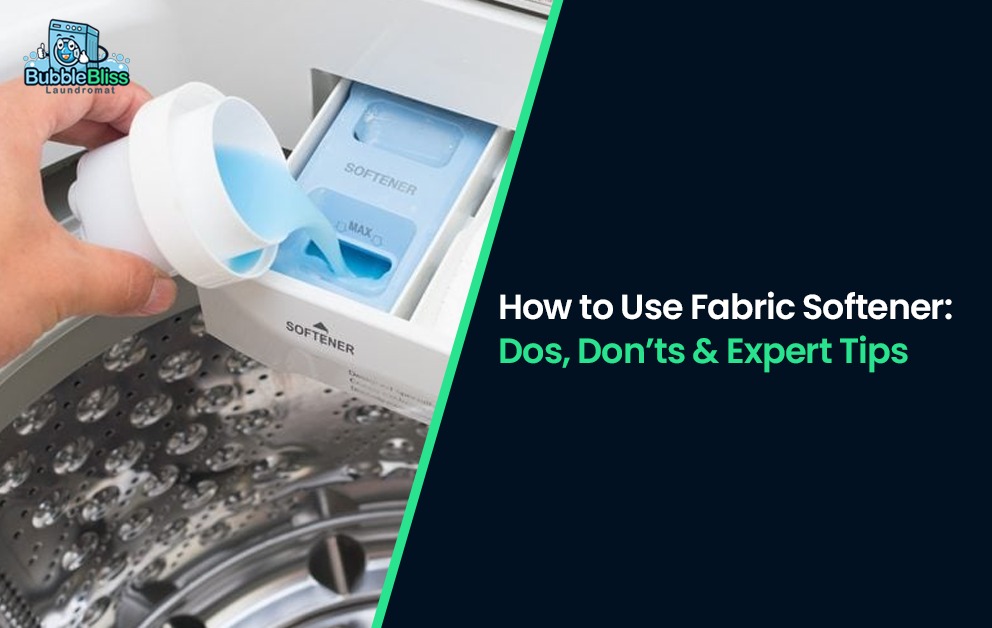
Learning how to use fabric softener correctly depends on machine cycle timing, accurate liquid dosage, and selective fabric application. You should pour liquid fabric conditioner directly into the washing machine’s dedicated dispenser drawer marked with an ISO flower icon so the unit automatically releases the formula during the final rinse cycle. Washing machines lacking an automatic dispenser tray require manual intervention. For these units, you should pre-dilute a baseline dose of 1 tablespoon (15 mL) of liquid softener with warm water and manually add the mixture during the final rinse.
Fabric conditioner performs a conditioning function rather than a cleaning function. Standard laundry detergents use anionic surfactants to emulsify soils and lift oils during the main wash cycle. Fabric softeners deploy cationic quaternary ammonium compounds during the final rinse cycle. These positively charged quats bond electrostatically to negatively charged textile fibers. This electrostatic bonding deposits a hydrophobic organic layer across the fabric. The coating reduces fiber-on-fiber friction, suppresses static charge generation, and neutralizes fabric stiffness.
Fabric softeners must be selectively omitted from performance textiles and safety-critical garments. Standardized laboratory testing confirms that applying cationic softeners to bath towels causes a 47%–48% loss in baseline water absorbency after 5–10 wash cycles by shifting the water contact angle from 0° to 68° . Microfiber cleaning cloths suffer a 68% reduction in lint-capture efficiency after 3 washes because quat lipids seal internal capillary channels. Technical athletic activewear experiences a 35%–50% decrease in Moisture Management Rating alongside trapped Micrococcus bacteria that induce persistent odor. Applying fatty tallow softeners to children’s sleepwear deposits a flammable lipid film. This deposition directly violates federal self-extinguishing safety capacity standards governed by the U.S. Consumer Product Safety Commission under 16 CFR Part 1615 and 1616.
What Is Fabric Softener and How Does It Work?
Fabric softener is a chemical post-wash conditioning treatment containing cationic quaternary ammonium compounds. Cationic quats electrostatically bond to negatively charged fibers during the rinse cycle. Positively charged surfactants adsorb onto exposed cellulose microfibrils to suppress the bound-water hydrogen-bonding network formed during natural drying. The chemical treatment reduces fiber sliding friction according to the formula:
$$\mu = \frac{F_f}{N}$$
where $\mu$ represents the friction coefficient, $F_f$ represents friction force, and $N$ represents normal load. Quat deposition neutralizes negative static charges generated by dryer agitation. Adsorbed quat molecules lower textile surface energy to produce a supple hand-feel. Encapsulated fragrance oils adhere to treated fiber surfaces to mask residual odors.
Fabric Compatibility Matrix
| Fabric Classification | Softener Recommendation | Quantitative Risk | Primary Authority |
| Cotton-polyester blends | Usually Suitable | Overdosing increases pilling by 47% at pH 8.9–9.4 | AATCC Test Method 150 |
| Bed sheets | Usually Suitable | Product buildup reduces fabric breathability | American Cleaning Institute |
| Bath towels | Avoid | 47%–48% absorbency loss after 5–10 washes | AATCC Test Method 79 |
| Microfiber cloths | Strict Avoid | 68% lint capture loss after 3 washes | NC State Textile Performance Lab |
| Technical activewear | Strict Avoid | 35%–50% wicking loss; traps Micrococcus bacteria | AATCC Test Method 135 |
| Water-repellent clothing | Strict Avoid | Destroys surface tension of DWR coatings | American Cleaning Institute |
| Flame-resistant sleepwear | Strict Avoid | Deposits flammable film; violates safety standards | U.S. CPSC 16 CFR 1615/1616 |
How to Use Fabric Softener Correctly
Following a structured step-by-step washing machine guide ensures maximum fabric softness while preventing waxy product buildup. Correct application requires verifying care symbols, measuring precise volumes, utilizing designated dispenser compartments, and observing cycle thermal limits.
Step 1 — Check the Care Label
Garment care tags comply with ASTM D5489-18 or ISO 3758:2023 international symbol standards. You should skip fabric conditioner on garments bearing explicit “Do Not Use Fabric Softener” warnings. Skipping softener on bath towels prevents a 47%–48% drop in baseline water absorbency. Excluding softener on microfiber cleaning cloths prevents a 68% reduction in lint-capture efficiency. Omitting softener on athletic activewear prevents a 35%–50% loss in Moisture Management Rating and stops Micrococcus bacterial odor retention. Skipping softener on children’s sleepwear preserves self-extinguishing flame resistance under 16 CFR Part 1615 and 1616.
Step 2 — Measure the Correct Amount
Standard concentrated liquid fabric softener typically recommends a baseline dose of 1 tablespoon (15 mL) per standard 8 lb laundry load. High-Efficiency front-load washing machines use 3–5 gallons (11.3–18.9 L) of rinse water per load. Traditional agitator top-load washing machines use 12–15 gallons (45.4–56.8 L) of rinse water per load. You should use cap measuring lines rather than free-pouring liquid to maintain precise chemical ratios. Overdosing fabric conditioner raises rinse water pH to 8.9–9.4. Overdosing increases pilling on cotton-polyester fabric blends by 47%. Excess dosage deposits waxy residues inside outer washing machine drums.
Step 3 — Use the Correct Compartment
Liquid softener belongs in the dispenser tray marked with the ISO flower icon ($❀$) or “Softener” label. Automatic siphon release during the final rinse cycle isolates cationic quats from anionic detergent suds. Ionic isolation prevents cationic and anionic surfactants from forming insoluble precipitates. Commercial laundromat washers utilize multi-cup dispenser tray layouts. If a shared laundromat machine lacks an operational dispenser tray, you should pre-dilute 1 tablespoon (15 mL) of softener in warm water. You must add this diluted solution manually during the final rinse cycle.
Step 4 — Never Pour Concentrated Softener Directly on Clothes
Pouring concentrated softener directly onto garments causes localized quat lipid saturation. Lipid saturation creates hydrophobic, blue-grey greasy stains on wet or dry textiles. Undiluted liquid fails to disperse uniformly across the laundry drum. You must re-wash spotted garments in warm water without added softener to remove un-extracted lipid deposits.
Step 5 — Let the Washer Release It During the Rinse
Washing machine processing follows a strict three-stage chemical and thermal sequence:
Wash (Anionic Suds)→Rinse/Condition (Cationic Quats)→Dry (Thermal Limit: ≤65∘C)
Anionic laundry detergent cleans soils during the main wash phase. The washing machine releases cationic fabric conditioner only after wash water drains complete. Dryer heat exceeding 65°C (149°F) triggers polymer cross-linking. Heat above 65°C permanently bakes quat polymers into synthetic and cellulose fibers.
Step-by-Step Protocol
| Step | Operational Action | Critical Violation to Avoid | Technical Risk & Primary Authority |
| 1 | Inspect ASTM D5489 care symbols | Automatic application on technical garments | Prevents functional degradation (ASTM D5489 / ISO 3758) |
| 2 | Sort loads by textile classification | Mixing technical fabrics with cottons | Prevents 47% towel absorbency drop (AATCC TM79) |
| 3 | Measure baseline dose (15 mL / 8 lb load) | Overdosing | Prevents 47% pilling increase & drum residues (AATCC TM150) |
| 4 | Fill dispenser drawer marked with flower icon ($❀$) | Pouring into main wash compartment | Prevents ionic suds neutralization (ACI) |
| 5 | Run main wash cycle | Adding softener before rinse cycle | Keeps anionic suds & cationic quats separate (ACI) |
| 6 | Siphon release during final rinse | Direct pouring onto wet/dry clothes | Prevents localized quat lipid saturation (ACI) |
| 7 | Tumble dry below 65°C ceiling | Drying above 65°C | Prevents permanent quat polymer cross-linking (AATCC TM135) |
When Should You Avoid Fabric Softener?
Laundry softener must be omitted from four specific textile classes. These excluded materials include bath towels, microfiber cloths, synthetic activewear, and children’s flame-resistant sleepwear. Fabric conditioner serves as a selective textile treatment rather than an automatic laundry step.
Towels
Cationic quats coat cellulose terry loops with a hydrophobic lipid film. This film shifts the fabric water contact angle from 0° to 68°. Bath towels lose 47%–48% of baseline water absorbency after 5–10 softener cycles under AATCC Test Method 79. You should replace liquid softener with ½ cup distilled white vinegar (pH 2.4) in the rinse cycle. Vinegar dissolves calcium scale to restore capillary action in cellulose fibers.
Activewear and Microfiber
Quat films coat engineered wicking pores on polyester and spandex activewear. This chemical coating reduces the Moisture Management Rating by 35%–50%. The film traps Micrococcus bacteria to create persistent body odor. Quats clog split channels in microfiber filaments. Microfiber suffers a 68% loss in lint-capture efficiency after 3 washes under NC State Textile Performance Lab testing. You should avoid drying heat above 65°C to prevent quat polymers from permanently cross-linking into synthetic fibers.
Flame-Resistant Garments
Fatty quat deposits leave a flammable organic lipid film on treated fabrics. This flammable film compromises self-extinguishing safety capacity under federal regulation 16 CFR Part 1615 and 1616.
Fabric Softener vs Dryer Sheets vs Dryer Balls
Liquid softeners deposit quaternary ammonium compounds that chemically coat fiber surfaces. Liquid laundry softener operates during the rinse cycle to coat wet fibers with a hydrophobic lipid film. Dryer sheets melt stearic acid coatings onto garments when dryer heat exceeds $50^\circ\text{C}$. Waxy residues from dryer sheets coat dryer drum walls and lint screens.
Wool dryer balls contain zero chemical conditioning agents and soften laundry purely through mechanical agitation and kinetic tumbling. Dryer balls do not deposit hydrophobic films, making them completely safe for bath towels, synthetic activewear, and microfiber cleaning cloths. Natural wool spheres cut overall drying time by 15%–25% across 1,000 cycles.
Conditioning Product Comparison
| Conditioning Product | Application Cycle Phase | Active Mechanism | Primary Function & Impact | Primary Authority |
| Liquid Softener | Wash Rinse Cycle | Cationic quats deposited via water dispersion | Binds electrostatically to wet fibers; coats textiles with a hydrophobic film | American Cleaning Institute |
| Dryer Sheet | Tumble Dryer Cycle | Heat-activated stearic acid or quat coating | Melts at $>50^\circ\text{C}$ to transfer waxy anti-static layer; coats dryer drums & filters | American Cleaning Institute |
| Wool Dryer Ball | Tumble Dryer Cycle | 100% natural wool spheres providing kinetic separation | Fluffs loops mechanically without chemical deposits; cuts drying time by 15%–25% | U.S. Department of Energy |
Common Fabric Softener Mistakes
Common fabric softener mistakes include liquid overdosing, wrong compartment placement, direct garment contact, universal application, and fragrance reliance. Overdosing raises rinse water pH to 8.9–9.4. Excess dosage increases poly-cotton blend pilling by 47% under AATCC Test Method 150. High dosage precipitates waxy lipid curds inside outer washer drums. Users should measure a baseline dose of 1 tablespoon (15 mL) of concentrated softener per 8 lb load using cap lines.
Adding softener during the main wash phase causes cationic quats to bind electrostatically with anionic detergent suds. This ionic neutralization ruins both garment cleaning and fiber conditioning. Softener must be added to the dispenser tray marked with an ISO flower icon for final rinse siphon release.
Pouring concentrated liquid directly on dry or wet clothes causes localized quat lipid saturation. Direct contact leaves hydrophobic blue-grey greasy stains on textiles. Direct-pour stains require re-washing in warm water without added conditioner.
Applying softener to every load clogs synthetic moisture-wicking pores to cause a 35%–50% Moisture Management Rating drop. Universal application violates 16 CFR Part 1615/1616 children’s sleepwear flammability standards. Softener must be reserved for everyday cottons and linens. Continuous quat accumulation on towels cuts absorbency by 47%–48% under AATCC TM79 testing. Coated towels require stripping using white vinegar in a hot wash.
Volatile masking scents mask Micrococcus bacterial biofilms feeding on trapped body lipids. Softened fabrics retain 4.2 times more bacteria in ISO 20743 assays compared to vinegar-rinsed fabrics. Users should apply pH-neutral enzyme detergents to eliminate odor-causing bacteria.
Laundry Processing Timeline
| Processing Stage | Estimated Duration Range | Operational Context & Governing Standard |
| Sort / care-label check | 5–10 min | Inspect care tags for ASTM D5489 symbols to prevent activewear coating |
| Product setup | 3–5 min | Measure baseline 1 tbsp (15 mL) dose using cap markers |
| Main wash cycle | 25–45 min | Main wash cycle operating with anionic detergent |
| Rinse cycle | 5–15 min | Siphon dispenser releases cationic quat solution |
| Tumble dry cycle | 30–60 min | Low-heat tumble drying (<65°C) to prevent polymer baking |
| Fold & inspect | 5–10 min | Final inspection for direct-pour spotting |
| Total DIY Time | ~70–145+ min | Reflects federal benchmark of 1.19 hrs/week spent on home laundering (BLS ATUS) |
Using Fabric Softener at an NYC Laundromat
Using fabric conditioner at an NYC laundromat requires inspecting commercial washing machine dispenser trays for residual quat residues before loading clothes. Shared commercial washers frequently feature clogged or damaged dispenser compartments. If a commercial washer lacks a functional tray, pre-dilute 1 tablespoon (15 mL) of liquid softener in warm water. Manually add this pre-diluted mixture directly to the drum during the final rinse cycle. Overloading commercial laundry drums prevents full water extraction during rinsing. Unextracted detergent and softener residues stiffen fabric fibers. Drying clothes on steam apartment radiators scorches natural cotton fibers.
NYC DIY Laundry Cost Formula
$$C_{\text{DIY}} = C_w + C_e + C_m + C_t$$
Where:
- $C_w$ = NYC water and sewer utility rate ($13.86 / 748\text{ gallons}$)
- $C_e$ = NY residential electricity price ($29.93\text{¢} / \text{kWh}$)
- $C_m$ = Commercial machine fees ($9.00–$14.00 total per wash and dry load)
- $C_t$ = Time and transit overhead value based on a 40.3-minute one-way commute
NYC Cost Matrix
| Operational Cost Element | NYC Benchmark Value | Primary Root Authority |
| Water + sewer utility | $13.86 / 748 gallons | NYC Water Board Rate Schedule |
| Electricity rate | 29.93¢ / kWh | U.S. EIA Electric Power Monthly |
| Commercial machine fees | $9.00 – $14.00 per wash/dry load | U.S. Bureau of Labor Statistics |
| Average weekly laundry time | ~1.19 hrs / week | U.S. BLS American Time Use Survey |
| NYC average commute | 40.3 min one-way | U.S. Census Bureau ACS |
Frequently Asked Questions
FAQ 1: Where do you put fabric softener in a washing machine?
Pour liquid fabric softener directly into the washing machine’s automatic dispenser tray marked with the ISO flower icon. This tray holds the liquid until the siphon releases it automatically during the final rinse cycle. For washing machines without a dispenser tray, pre-dilute 1 tablespoon (15 mL) of softener in warm water. Add this pre-diluted mixture manually during the final rinse cycle.
FAQ 2: Can you use fabric softener on every type of clothing?
No, fabric softener must be skipped on technical apparel bearing warnings against softener use. Cationic quats clog synthetic wicking pores and reduce microfiber cleaning efficiency by 68%. Softeners violate federal flammability safety regulations under 16 CFR Part 1615 when applied to children’s sleepwear.
FAQ 3: Should you use fabric softener on towels?
No, you should never use liquid fabric softener or dryer sheets on bath towels. Cationic surfactants coat cotton terry loops with a hydrophobic lipid film to seal cellulose pores. Standardized testing shows towels lose 47%–48% of baseline absorbency after 5–10 softener washes under AATCC Test Method 79. Use distilled white vinegar in the rinse dispenser tray instead.
FAQ 4: Is fabric softener the same as detergent?
No, laundry detergent and fabric softener perform opposite chemical functions. Detergent contains anionic surfactants that emulsify dirt and oils to clean garments during the main wash cycle. Fabric softener contains cationic surfactants that coat clean fibers during the final rinse cycle to neutralize static and reduce friction. Softeners do not wash or clean clothes.
FAQ 5: How much fabric softener should I use?
Use a baseline dose of 1 tablespoon (15 mL) of concentrated liquid fabric softener per standard 8 lb laundry load. High-Efficiency washers use only 3–5 gallons (11.3–18.9 L) of rinse water per load. Precise cap-line measurement prevents chemical overdosing. Overdosing increases poly-cotton pilling by 47% at pH 8.9–9.4 under AATCC Test Method 150.
FAQ 6: How do I use fabric softener if my washer has no dispenser?
Wait for your washing machine to drain the wash water and fill for the final rinse cycle. Mix 1 tablespoon (15 mL) of liquid softener with warm water. Pour the diluted mixture directly into the rinse water. Avoid direct contact with fabric to prevent hydrophobic blue-grey greasy stains.
FAQ 7: What can I use instead of fabric softener?
Add ½ cup of distilled white vinegar (pH 2.4) to the rinse dispenser tray. Vinegar strips alkaline detergent residues and relaxes cotton fibers without depositing waxy coatings. For automatic dryers, use 100% wool dryer balls to fluff laundry mechanically. Wool dryer balls reduce drying time by 15%–25%.
FAQ 8: Is professional wash and fold worth it for busy NYC residents?
Yes, professional wash and fold provides significant economic and operational value for NYC residents. New Yorkers average a 40.3-minute commute and spend 1.19 hours per week on DIY laundering. Local laundromats cost $9.00–$14.00 per load in machine fees alone. Bubble Bliss handles fabric-specific sorting to preserve technical apparel and save valuable urban time.
Conclusion
Correct fabric softener use depends on verifying care labels, measuring accurate dosages, utilizing dispenser compartments, and observing rinse timing. Cationic softeners condition everyday cottons but degrade towels, activewear, microfiber, and flame-resistant sleepwear. Understanding how to use fabric softener ensures optimal textile performance while protecting washing machine efficiency.
Bubble Bliss NYC Wash & Fold CTA
Are you unsure which clothes require fabric softener and which must skip it to avoid a 47% towel absorbency drop? Bubble Bliss handles fabric-specific sorting, custom wash temperatures, and quat-free towel care. Select professional [NYC Wash & Fold service](Wash & Fold) or schedule your [laundry pickup and delivery in NYC](Valet / Pickup) to eliminate $9.00–$14.00 DIY laundromat load fees and reclaim 1.19 hours of weekly time.