
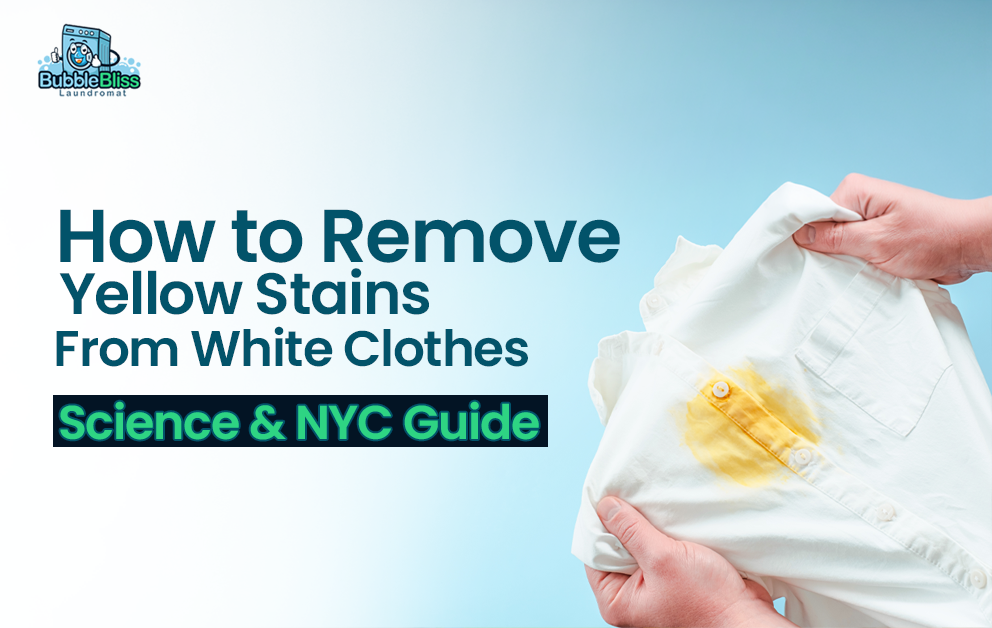
Yellowing on white textiles is not simply superficial dirt. It represents a complex chemical matrix of oxidized body lipids, lingering antiperspirant aluminum salts, and atmospheric gas reactions. Urban apartment environments in New York City exacerbate this degradation through iron-heavy municipal tap water and localized closet humidity. Standard chlorine bleach intensifies these specific discoloration patterns by chemically bonding proteins to textile fibers. Effective textile restoration requires specialized oxygen-based chemical agents to break down the oxidized lipid bonds without damaging the underlying fabric structure.
In this discussion we will know how to remove yellow stains from white clothes.
What Causes Yellow Stains on White Clothes? (Armpits, Storage & NYC Water)
Fabric yellowing occurs through two primary chemical pathways driven by environmental exposure and body chemistry.
Underarm discoloration originates from the reaction between human apocrine sweat lipids and aluminum-based antiperspirant compounds. When these organic secretions interact with textile fibers, they oxidize and polymerize over time.
Storage yellowing results from prolonged exposure to trapped atmospheric gases and lingering detergent residues inside enclosed spaces. Urban storage conditions in New York City intensify this process due to localized closet humidity and elevated mineral content in municipal tap water. Iron particles present in aging plumbing systems embed directly into cotton weaves, accelerating oxidative breakdown during long periods of non-use.
How to Get Yellow Stains Out of White Shirts: Step-by-Step Chemical Treatments
To know how to remove yellow stains from white clothes, you have to follow certain steps. Restoring yellowed white garments requires targeted chemical treatments designed to cleave oxidized lipid bonds and denature protein residues. Effective protocols match specific bleaching agents to fabric tolerances. Standard methods utilize oxygen-based oxidizers, enzymatic boosters, and controlled alkaline solutions to lift discoloration without compromising structural integrity.
Fabric Classification Matrix (Table 1)
| Fabric Entity | Structural Tolerance | Recommended Agent | Restricted Chemical |
| Cotton & Linen | High durability; withstands high alkalinity. | Baking soda, hydrogen peroxide, oxygen bleach. | Chlorine bleach (causes yellowing on protein soils). |
| Silk & Wool | Fragile protein structures; alkali sensitive. | Dilute acetic acid, mild enzyme detergents. | Hydrogen peroxide at high concentrations, chlorine bleach. |
| Synthetic Blends | Moderate thermal and chemical resistance. | Sodium percarbonate, gentle oxygen pre-soaks. | High heat drying, undiluted harsh solvents. |
The Baking Soda & Hydrogen Peroxide Paste Method (3:1 Ratio)
The baking soda and hydrogen peroxide paste method utilizes a three-to-one volumetric ratio of sodium bicarbonate to hydrogen peroxide. This mixture generates active hydroxyl radicals that target and break down chromophore carbon-carbon double bonds (C=C). The reaction oxidizes yellow pigments back into colorless compounds on cotton and linen fibers.
- Mix three parts baking soda (NaHCO3) with one part hydrogen peroxide (H2O2) in a non-metal container.
- Apply the resulting paste directly to localized armpit and collar stains.
- Agitate the mixture gently using a soft-bristled brush.
- Allow the paste to penetrate the textile fibers for thirty minutes.
- Rinse the garment thoroughly with cold water before regular laundering.
Oxygen Bleach Soaking vs. The Chlorine Bleach Myth
Chlorine bleach permanently damages protein-based yellow stains through an adverse chemical reaction known as chloramination. Sodium percarbonate, commonly classified as oxygen bleach, releases active hydrogen peroxide when dissolved in warm water. This mechanism lifts discoloration safely without darkening embedded organic residues or degrading synthetic blends.
- Sodium hypochlorite interacts with human sweat proteins to create yellow-brown polymers.
- Oxygen bleach avoids this pitfall entirely through non-chlorine oxidation pathways.
- Dissolve two tablespoons of sodium percarbonate powder in a basin of warm water.
- Submerge the yellowed white garment completely for a minimum of four hours.
- Monitor the immersion process to ensure uniform color restoration across the fabric surface.
How to Remove Old Yellow Stains on White Clothes After Storage
Removing aged yellow stains from stored white clothes requires an intensive chemical pre-soak followed by an acid neutralization rinse. Long-term storage sets hydroperoxide residues deep within textile weaves. Standard washing cycles cannot dissolve these polymerized layers without a dedicated multi-stage restoration protocol. To learn How to Remove Yellow Stains from white clothes you have to:
- Prepare a concentrated solution of warm water and powdered oxygen bleach.
- Submerge the aged garment into the basin for an overnight soak lasting at least eight hours.
- Drain the soaking solution and transfer the textile to a washing machine cycle.
- Introduce a cup of white vinegar during the rinse phase.
- The acid neutralizes residual alkalinity and dissolves set-in hydroperoxide compounds.
Step-by-Step Action Protocol Table (Table 4)
| Stain Origin | Primary Treatment Protocol | Secondary Action | Target Contact Time |
| Armpit Sweat Lipids | Baking soda and hydrogen peroxide paste (NaHCO3+H2O2) | Cold water rinse and enzyme wash | 30 minutes |
| General Storage Yellowing | Warm water sodium percarbonate soak | Vinegar acid rinse | 8 hours (Overnight) |
| Iron-Heavy Water Discoloration | Oxalic acid or commercial rust remover | Thorough fresh water flush | 15 minutes |
NYC Apartment Hacks: Storage Yellowing, Hard Water & Radiator Hazards
Urban living conditions in New York City present unique textile preservation challenges due to aging municipal infrastructure and spatial constraints. Aging city plumbing deposits trace metal ions directly into laundry cycles. Historic steam heating systems create extreme localized drying hazards. Apartment dwellers can reverse these environmental impacts using targeted chemical chelators and strict temperature management protocols to make yellowed white clothes white again.
NYC Tap Water Iron Oxidation & Acid Souring
Trace iron concentrations exceeding 0.3mg/L in aging municipal water lines deposit microscopic metal particles directly onto cotton fibers. These iron precipitates oxidize during laundering to create persistent reddish-yellow discoloration. Introducing distilled white vinegar into the rinse cycle provides an effective acidic environment. Acetic acid molecules chelate the dissolved iron ions, lifting the metal deposits and restoring optical whiteness to the fabric.
The Steam Radiator Hazard & Thermal Setting Formula
Drying damp white garments directly on hot steam radiators exceeding $150^\circ\text{F}$ ($65.5^\circ\text{C}$) induces permanent fiber degradation. High localized surface heat bakes residual protein and lipid matrices into the core of cotton weaves.
DIY Restoration Effort vs. Bubble Bliss Professional Valet ROI
Restoring yellowed textiles independently requires significant time spent scrubbing in coin-operated laundromats. Professional valet delivery services offer a cost-effective alternative that eliminates manual labor while protecting delicate garment structures.
Financial Cost Analysis Table (Table 2)
| Restoration Method | Direct Material Cost | Labor Investment | Risk of Fabric Damage |
| DIY Coin Laundromat | $12.50 (Reagents & Coins) | 3.5 Hours | Moderate (Manual Scrubbing) |
| Professional Valet Service | $18.00 (Service Flat Rate) | 0.1 Hours | Low (Controlled Chemistry) |
Processing Timeline Table (Table 3)
| Operational Stage | DIY Protocol Duration | Professional Valet Duration |
| Initial Pre-Soak | 8 Hours (Overnight) | 4 Hours (Automated Immersion) |
| Active Laundering | 1.5 Hours | 0.2 Hours (Drop-off / Pickup) |
| Total Turnaround | 12.0 Hours | 24.0 Hours (Scheduled Return) |
Frequently Asked Questions About Removing Yellow Stains
Q1: Why do white clothes turn yellow in armpits?
Yellow armpit stains are caused by a chemical reaction between human sweat lipids, proteins, and the aluminum zirconium salts found in antiperspirants. Over time, this combination forms a water-insoluble complex that bonds tightly to cotton fibers, oxidizing into a visible yellow stain.
Q2: Does chlorine bleach remove yellow armpit stains?
No. Chlorine bleach reacts with antiperspirant aluminum salts and sweat proteins, causing a chloramination reaction that actually darkens yellow stains into brown spots. To whiten yellowed armpits safely, use an oxygen-based bleach or a paste made from hydrogen peroxide and baking soda.
Q3: How do you get old yellow stains out of stored white clothes?
Remove old storage stains by soaking garments in warm water mixed with sodium percarbonate (oxygen bleach) for two hours. Pre-treat stubborn spots with a paste of three parts baking soda and one part 3% hydrogen peroxide, then wash with an acidic vinegar rinse.
Q4: Will baking soda and hydrogen peroxide ruin colored elements on white shirts?
A paste of 3% hydrogen peroxide and baking soda is generally safe for colorfast white garments with minor trim. However, hydrogen peroxide is a mild bleaching agent, so test the mixture on an inconspicuous inside seam first if the garment features delicate, non-colorfast embroidery or print.
Q5: Why do white clothes turn yellow in storage closets?
Storage yellowing occurs when unremoved body lipids and residual laundry detergents undergo auto-oxidation over time in dark, enclosed spaces. Exposure to atmospheric nitrogen oxide gases (NOx) in unventilated NYC apartment closets accelerates this chemical breakdown, creating yellow chromophores on cotton fibers.
Q6: How does white vinegar help whiten yellowed clothes?
White distilled vinegar contains dilute acetic acid, which lowers rinse water pH to dissolve residual detergent soap scum and chelate iron minerals found in NYC tap water. Stripping these dull mineral deposits restores natural cotton brightness without damaging delicate textile fibers.
Q7: Can steam radiators permanently bake yellow stains into clothes?
Yes. Drying damp, yellow-stained white clothing on hot steam radiators exceeding 150 degree Fahrenheit causes intense thermal setting. High heat permanently bakes unremoved protein and lipid complexes deep into the cotton fiber matrix, turning faint yellow spots into permanent brown scorch stains.
Q8: How can I prevent yellow armpit stains from forming on white shirts?
Prevent yellowing by switching to an aluminum-free deodorant, allowing antiperspirant to dry completely before dressing, and washing white shirts immediately after wearing. Never let sweat-soaked clothes sit in a damp hamper where body lipids can oxidize into cotton fibers.
Conclusion: Restore Your Whites to Bright Perfection
Restoring yellowed white garments requires targeted chemical restoration instead of standard laundering cycles. Avoid chlorine bleach because it permanently darkens protein soils through chloramination. Treat localized armpit discoloration using a three-to-one baking soda and hydrogen peroxide paste. Remove aged storage yellowing with an overnight sodium percarbonate oxygen soak. Eliminate trace municipal iron deposits by adding distilled white vinegar to your wash rinse cycle. Protect clothing fibers by keeping damp garments away from high-temperature steam radiators.
Restore Your Wardrobe Effortlessly: Bubble Bliss NYC Laundry Valet
Bubble Bliss provides specialized commercial laundry valet services across New York City to restore yellowed garments to spotless condition. Our professional wash-and-fold operations utilize advanced enzymatic pre-soaks, oxygen-based bleaching agents, and precise temperature-controlled drying techniques to eliminate deep-set stains. Busy NYC residents can schedule doorstep pickup and delivery online today to simplify textile care.