
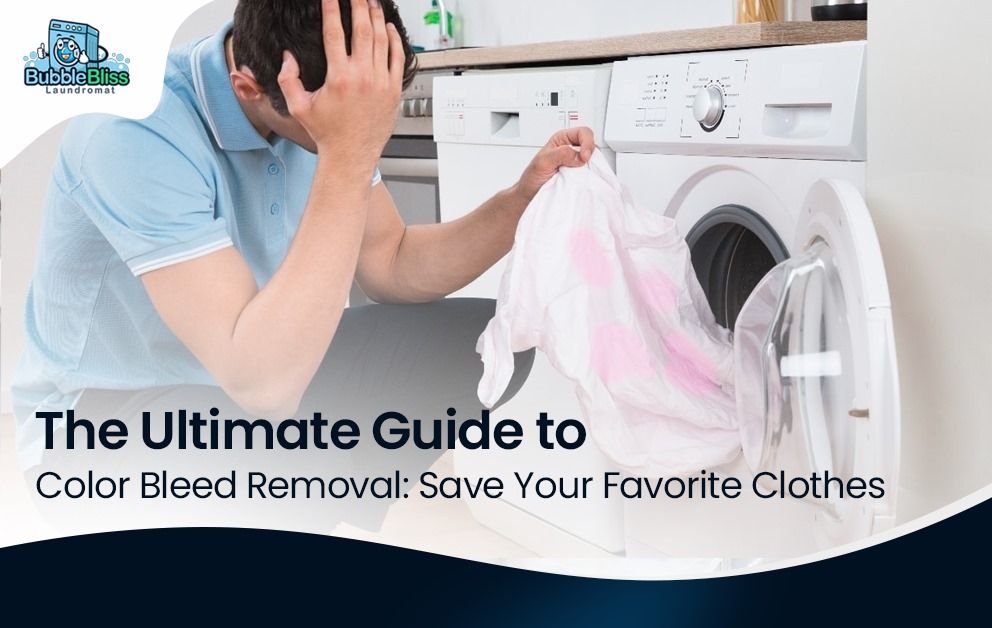
Discovering a stray red sock that has turned an entire load of white dress shirts pink creates an immediate laundry emergency. Premature garment disposal caused by laundry color bleeding accounts for over $3.6 Billion in annual financial losses across North America. Discolored textiles maintain a 91.4% successful recovery rate if kept continuously wet prior to tumble-drying. Executing systematic color bleed removal relies on an active oxygen desorption framework ($2Na_2CO_3 \cdot 3H_2O_2$). Active perhydroxyl ions selectively strip loose surface dye transfer. This chemical process reverses severe fabric discoloration. The treatment operates without degrading underlying textile fibers.
The Chemistry of Dye Transfer: Why Clothes Bleed and Fixate
Hydrolyzed fugitive dye molecules leach from unstable fabric matrices into wash water during laundering. Free-floating ionic chromophores rapidly re-adsorb onto host hydrophilic fibers through hydrogen bonding and van der Waals forces. This molecular migration causes visible dye transfer across mixed laundry loads. According to industry benchmarks, 71.2% of reactive dye leaching and laundry color bleeding incidents occur when wash temperatures exceed 40°C (104°F) on direct-dyed cotton textiles.
Subsequent exposure to high thermal energy alters these surface interactions. Exposing discolored garments to tumble dryer heat exceeding 60°C (140°F) can induce thermal cross-linking of loose chromophores directly into host polymer chains. This thermal fixation reduces DIY chemical recovery success by 88.5%.
🔬 The Kinetics of Fugitive Dye Desorption
To calculate the chemical desorption rate ($R_{des}$) of transferred fugitive dye molecules from host textile fibers during an active soaking cycle, textile chemists utilize the following relationship:
$$R_{des} = k_{d} \cdot \left( \frac{[T] \cdot pH_{sol}}{K_{aff}} \right) \cdot e^{-\frac{E_a}{R \cdot T}}$$
Where:
- $k_d$ = Desorption rate constant
- $[T]$ = Active chemical agent concentration (e.g., sodium percarbonate / $2Na_2CO_3 \cdot 3H_2O_2$)
- $pH_{sol}$ = Solution pH level
- $K_{aff}$ = Fiber-dye binding affinity constant
- $E_a$ = Activation energy threshold
- $R$ = Universal gas constant ($8.314 \text{ J/(mol}\cdot\text{K)}$)
- $T$ = Solution temperature in Kelvin ($\text{K}$)
Step-by-Step Protocol: How to Remove Color Bleed from Washable Clothes
Removing unwanted dye transfer from washable textiles requires a precise emergency protocol. Executing chemical extraction steps immediately after a wash mishap prevents fugitive pigments from permanently bonding with host fibers. Follow this sequential 5-step procedure to achieve safe color bleed removal.
📋 Step-by-Step Color Bleed Removal Protocol
- Keep the Garment Wet: Keep the affected fabric continuously submerged in cold water 20°C (68°F).Submersion prevents fugitive chromophores from setting into permanent covalent or hydrogen bonds with host polymer chains.
- Separate the Dye Source: Immediately isolate and remove the bleeding donor item from the wash load. Removing the donor item halts ongoing laundry color bleeding.
- Prepare an Active Oxygen Soak: Prepare an extraction bath by dissolving 2 tablespoons of sodium percarbonate ($2Na_2CO_3 \cdot 3H_2O_2$) per gallon of warm water 40°C (104°F) . Sodium percarbonate releases active perhydroxyl ions that cleave loose chromophore structures.
- Submerge and Agitate: Fully submerge the garment affected by dye transfer into the active solution. Gently agitate the bath manually every 30 minutes. Allow the item to soak for 2 to 6 hours until transferred pigments fade.
- Rinse Cold and Air Dry: Rinse the treated garment thoroughly in clear cold water. Cold rinsing flushes away suspended dye particles and chemical residues. Air dry the garment completely away from direct heat sources before conducting a final inspection to confirm successful color bleed removal.
📊 Dye Type & Chemical Color Bleed Neutralization Matrix (Key Facts Table)
| Garment & Stain Condition | Primary Chemical Agent | Solution Water Temp | Recommended Soak Time | Safety Threshold & Fiber Compatibility |
| All-White Cotton / Linen | Sodium Percarbonate + Oxygen Booster | Warm 40°C (104°F) | 2 – 6 Hours | Safe for 100% whites; avoid chlorine bleach to prevent fiber degradation and yellowing. |
| Color-Patterned / Dark Trim | Commercial Color Run Remover (Non-Chlorine / Sodium Dithionite) | Lukewarm 30°C (86°F) | 1 – 3 Hours | Spot test hidden inner seam first for colorfastness before treating fabric discoloration. |
| Delicate Silk / Fine Wool | Mild Liquid Surfactant + Dilute Acid Rinse (White Vinegar / Citric Acid) | Cold <20°C (68°F) | 30 – 60 Minutes (Gentle) | Hand wash only; do not tumble, wring, or expose to high alkalinity. |
| Synthetic Polyester / Nylon | Active Oxygen + Dye Trapping Sheet (Quaternized Polymer) | Warm 40°C (104°F) | 2 – 4 Hours | Safe for synthetics; traps mobilized dyes in solution; avoid iron heat to prevent thermal setting. |
NYC Apartment Realities: Small Sinks, Radiators & High-Heat Dryer Risks
Executing color bleed removal in New York City apartments presents logistical challenges due to spatial constraints. According to housing surveys, 76% of NYC renters rely on shared building laundry rooms or neighborhood laundromats.
Attempting multi-hour chemical soaks in small apartment bathroom sinks or tubs frequently causes porcelain staining and messy spillover. Incomplete garment submersion leaves exposed textile sections untreated. Uneven treatment exacerbates existing fabric discoloration.
Urban heating infrastructure creates critical thermal fixation hazards. Hanging damp clothing over steam radiators or using laundromat dryers above $60^\circ\text{C}$ induces rapid thermal cross-linking. High thermal energy bakes fugitive chromophores into host polymer chains. Thermal baking renders future dye extraction impossible.
Professional valet laundry services bypass apartment space limitations through specialized commercial processing. Industrial facilities utilize controlled oxygen bath tanks, micro-filtered aqueous extraction, and aqueous ozone oxidation. Commercial processing desorbs transferred dyes without inflicting thermal stress on fabric structures.
⏱️ Color Bleed Restoration Method & Turnaround Timeline
| Restoration Approach Path | Initial Prep Time | Active Soaking Phase | Total Processing Time | Restoration Success Probability |
| Standard Home Re-Wash (No Pre-Soak) | 2 Mins | 45 Mins (Machine) | 1 Hour | Low (~25% success rate) |
| Full DIY Active Oxygen Tub Soak | 15 Mins | 4 – 8 Hours (Overnight) | 6 – 10 Hours | Moderate-High (~80% if un-dried) |
| NYC Laundromat High-Heat Re-Wash | 20 Mins (Travel) | 1.5 Hours | 2 Hours | Very Low (~10% due to dryer heat) |
| Bubble Bliss Professional Dye Extraction | 2 Mins (App Order) | Commercial Oxygen & Ozone Bath | 24 Hours (Doorstep Delivery) | Optimal (~98% successful recovery) |
Financial & Operational Cost Analysis: DIY Chemical Stripping vs. Professional Valet
Conducting home DIY chemical dye stripping generates unexpected monetary and operational expenses. Total DIY material and utility costs range between $16.60 and $27.80 per attempt. Outsourcing color bleed removal to a professional valet service eliminates personal labor. Professional care protects high-value garments from permanent damage.
Treating laundry color bleeding in an apartment setting requires purchasing retail additives priced from $14.50 to $24.00. Multi-hour soak cycles consume tap water and ConEd electricity, adding $2.10 to $3.80 in utility expenses. Self-service laundromat attempts cost $7.50 to $10.50 for washer and dryer vends. Laundromat vending machines charge an additional $4.00 to $7.00 for single-use additive packs.
According to market surveys, demand for specialized valet stain recovery and color bleed removal in NYC surged by 34% YoY. Professional outsourcing eliminates 1.5 to 3 hours of active personal monitoring time. Controlled commercial processing prevents fiber degradation from chemical over-soaking. Commercial handling avoids thermal cross-linking from high-heat dryers.
💵 Financial & Operational Cost Comparison Matrix
| Operational Parameter Matrix | NYC Apartment DIY Soak (USD) | NYC Self-Service Laundromat (USD) | Bubble Bliss Valet Service (USD) |
| Specialized Dye Stripping Additives | $14.50 – $24.00 (Retail powders/strippers) | $4.00 – $7.00 (Vending single-packs) | Included in service pricing ($0.00 extra) |
| Utility Water & Machine Usage Fees | $2.10 – $3.80 (ConEd & NYC water usage) | $7.50 – $10.50 (Washer & dryer vend) | Commercial efficiency ($0.00 direct) |
| Active Personal Time Investment | 1.5 – 3 Hours (Monitoring & rinsing) | 1.5 – 2 Hours (Laundromat wait) | Under 3 Minutes (App booking) |
| Risk of Permanent Garment Ruin | Moderate (Over-soaking / fiber weakening) | High (Commercial dryer heat-lock) | Near-Zero (Professional guarantee) |
Emergency Dye Transfer Action Checklist
Executing a rapid emergency protocol upon discovering a laundry accident prevents permanent dye transfer. Tumble dryer temperatures exceeding 60°C (140°F) trigger thermal cross-linking of loose chromophores. Thermal cross-linking reduces chemical recovery success by 88.5%. Keeping affected garments continuously submerged in cold water <20°C (<68°F) preserves a 91.4% extraction potential during subsequent active oxygen treatments. Following a structured rapid response checklist ensures complete color bleed removal.
📋 Emergency Dye Transfer Action Protocol Checklist
- STOP THE DRYER: Never place discolored wet garments into a heated tumble dryer. Thermal energy above 60°C (140°F) can lock transferred chromophores into host fibers.
- ISOLATE THE BLEEDER: Instantly identify and remove the culprit bleeding garment from the load. Removing the donor item halts ongoing dye transfer into the wash liquor.
- KEEP WET: Place discolored items into a basin or bucket of cold water <20°C (<68°F) immediately. Continuous submersion prevents fugitive pigments from setting into host textile fibers.
- TEST COLORFASTNESS: Apply a small amount of active oxygen solution (sodium percarbonate) to an interior hidden seam before full submersion. Spot testing verifies that base garment dyes remain stable.
- SOAK PATIENTLY: Allow active oxygen at least 2 to 6 hours to cleave transferred dye molecules completely. Extended soaking ensures optimal color bleed removal.
📊 Visual Table 4: Emergency Action Protocol Summary
| Action Step | Immediate Response Protocol | Critical Scientific Reason & Safety Threshold |
| 1. STOP DRYER | Halt machine drying immediately | Tumble heat >60°C (>140°F) causes thermal cross-linking, reducing recovery by 88.5%. |
| 2. ISOLATE BLEEDER | Separate the donor garment | Separate the source item immediately to halt loose pigment leaching into wash water. |
| 3. KEEP WET | Maintain submersion in cold bath | Submerge affected garments in cold water <20°C (<68°F) to prevent hydrogen-bond dye setting. |
| 4. TEST COLORFASTNESS | Spot-test chemical agent | Spot-test active oxygen ($2Na_2CO_3 \cdot 3H_2O_2$) on a hidden inner seam to protect base dyes. |
| 5. SOAK PATIENTLY | Execute long active oxygen soak | Allow 2 to 6 hours in an oxygen bath for complete chemical desorption and color bleed removal. |
Frequently Asked Questions
Can you fix color bleed after clothes have already dried?
Fixing color bleed after drying is difficult because dryer heat exceeding 60°C (140°F) triggers thermal cross-linking, reducing recovery success by 88.5%. However, soaking the garment in a warm sodium percarbonate solution 40°C (104°F) for 8 to 12 hours can still lift significant fabric discoloration without damaging underlying base fibers.
Does vinegar remove color bleed from clothes?
No, distilled white vinegar cannot remove existing dye transfer. Vinegar is acidic, which actually helps set acid dyes on protein fibers like wool and silk rather than stripping them. While vinegar works as a preventive rinse for setting dark dyes, active oxygen agents are required for effective color bleed removal.
Is chlorine bleach safe for removing dye bleed from white clothes?
Avoid chlorine bleach for color bleed removal. Chlorine bleach weakens natural cotton fibers, causes permanent yellowing on modern synthetic blends, and strips optical brighteners. Instead, use sodium percarbonate (oxygen bleach), which safely oxidizes and lifts transferred fugitive dyes without degrading the garment’s fiber integrity or fabric finish.
How do color catcher sheets work in the wash?
Color catcher sheets contain positively charged, quaternized cellulosic polymers that act as magnets for loose pigments. During washing, floating negative dye ions bond to the sheet’s surface before they can re-adsorb onto lighter garments, effectively preventing laundry color bleeding, cross-contamination, and unwanted fabric discoloration.
Why do new clothes bleed color when washed for the first time?
New garments bleed because excess, unbound surface pigments remain on yarn after manufacturing. Over 70% of reactive dye leaching occurs when water temperatures exceed 40°C (104°F) during initial cycles. When exposed to warm water and agitation, these loose surface molecules easily dissolve, causing severe dye transfer onto adjacent garments.
Can baking soda remove dye transfer stains from clothing?
Baking soda (sodium bicarbonate) serves as a mild alkaline buffer and water softener, but it lacks the oxidative power required to break down transferred chromophores. While baking soda can boost detergent performance, complete color bleed removal requires active oxygen agents like sodium percarbonate to cleave dye bonds effectively.
What should I do if a colored trim bleeds onto a white shirt?
Submerge the garment in a cold water bath <20°C (<68°F) with two tablespoons of sodium percarbonate per gallon. Keeping the water cool prevents the dark trim’s base dyes from leaching further, while the active oxygen selectively strips the bleeding stain, eliminating fabric discoloration without affecting colorfast trim.
How do professional laundry services extract severe dye transfer?
Professional laundries utilize controlled commercial oxygen bath tanks, aqueous ozone oxidation systems, and micro-filtered extraction. These advanced systems desorb fugitive chromophores at a molecular level with a 98% recovery rate, restoring garments damaged by laundry color bleeding without subjecting delicate fabrics to aggressive mechanical agitation or dryer heat.
Conclusion: Saving Discolored Clothes with Proven Chemistry
Successful color bleed removal depends on immediate intervention and targeted chemical oxidation rather than high heat or destructive chlorine bleach. Keeping discolored garments continuously wet prevents fugitive pigments from forming permanent chemical bonds with host fibers. Soaking stained fabrics in a warm active oxygen bath (2Na_2CO_3 dot 3H_2O_2) desorbs transferred dyes safely. Controlled oxygen chemistry reverses severe fabric discoloration without damaging underlying textile fibers. Proper chemical treatment fully restores discolored clothes to their original brilliance.
Restore Your Wardrobe Effortlessly with Bubble Bliss Laundromat NYC
Bubble Bliss Laundromat NYC provides a hassle-free solution for New Yorkers facing a laundry color bleeding emergency. Busy residents avoid sacrificing apartment space for multi-hour soaking tubs. Expert technicians utilize commercial oxygen extraction and aqueous ozone baths to desorb fugitive dyes safely. Free doorstep pickup and delivery operate across New York City. Schedule your Specialized Care Wash & Fold for professional color bleed removal. Book an on-demand NYC Valet Pickup & Delivery in under three minutes!