
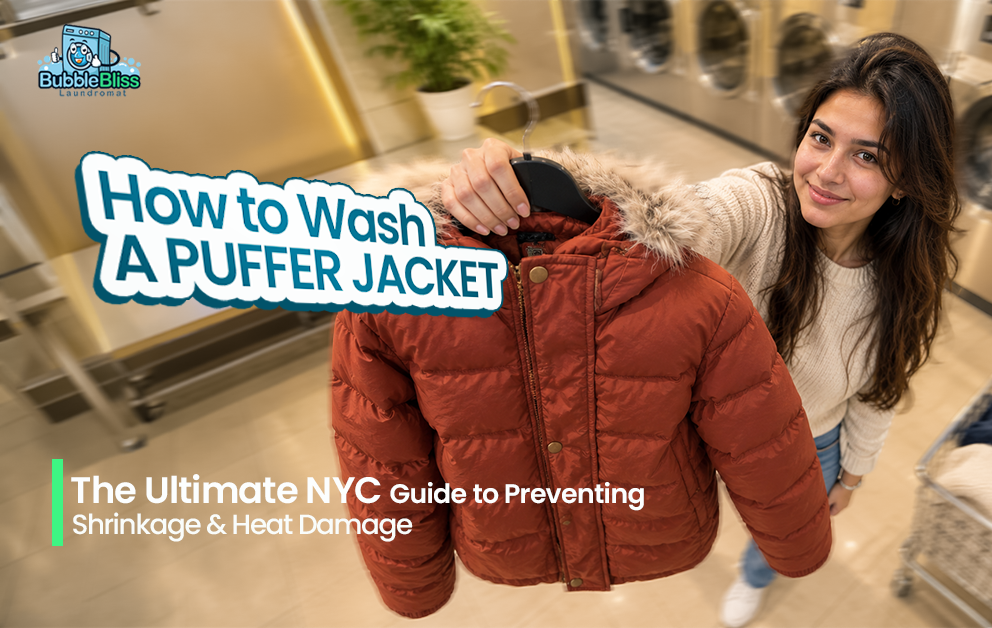
To wash a puffer jacket, first check its care label and identify whether it contains down or synthetic insulation. If machine washing is permitted, use a gentle cycle and a compatible detergent. Dry according to the manufacturer’s instructions, redistribute clumped insulation, and ensure the jacket is completely dry before storing.
Winter jackets collect sebum (natural skin oils), perspiration, urban grime, and road salt over months of daily wear. Learning how to wash a puffer jacket properly removes these residues without flattening the garment or ruining its warmth.
A puffer jacket is a quilted outerwear coat filled with insulating material stitched into separate chambers, called baffles. Whether your jacket relies on natural down clusters or synthetic polyester fibers, its warmth depends on loft—the thickness and fluffiness of the insulation that traps warm air close to your body. Because natural feathers and synthetic fibers react differently to water, detergent, and heat, cleaning methods vary across garments. Checking the sewn-in manufacturer care label is always the first step, as specific brand instructions override general laundry rules.
Can You Wash a Puffer Jacket in a Washing Machine?
Yes, most puffer jackets can be cleaned in a washing machine if the manufacturer’s care label permits machine washing. Before loading the drum, verify that the garment has no torn seams, loose stitching, or unsealed holes that could leak insulation during agitation.
Examine the care label for water temperature limits, cycle restrictions, and drying symbols. Remove detachable fur trim, hoods, or belts, and verify whether the outer shell features a durable water repellent (DWR) finish—a surface coating that causes water to bead up rather than soak into the fabric—which requires compatible cleaning agents.
Down vs. Synthetic Puffer Jackets: Know What You’re Washing
Understanding the anatomy of your winter coat prevents permanent damage. A puffer jacket pairs a protective outer shell—typically woven nylon or polyester—with an internal insulating fill.
Natural down insulation comes from the soft undercoating of ducks or geese. Its quality is often measured by fill power, which indicates the volume in cubic inches that one ounce of down occupies under standardized testing conditions. Synthetic insulation uses engineered polyester fibers designed to mimic down’s air-trapping structure while retaining warmth better when damp. According to outdoor apparel manufacturers such as Columbia Sportswear and Patagonia, matching your cleaner and drying method to the specific fill type preserves thermal performance.
| Material or component | Key characteristic | Cleaning requirement | Primary risk |
| Natural down | High-loft clusters that trap air efficiently | Down-specific, residue-free detergent | Clumping and loss of loft from harsh cleaners |
| Synthetic polyester insulation | Resilient spun polyester fibers | Mild, care-label-approved detergent | Fiber melting or compression from high heat |
| Nylon shell | Lightweight, smooth woven exterior | Gentle mechanical action and low heat | Abrasion, snags, or heat warping |
| Polyester shell | Durable, quick-drying synthetic weave | Label-specified water temperature | Heat damage or surface shine from hot dryers |
| DWR coating | Surface treatment that repels light moisture | Non-detergent or technical outerwear wash | Stripped water repellency from standard soaps |
| Quilted baffles | Stitched chambers keeping fill distributed | Front-loading washer without central agitator | Torn baffles and shifting insulation |
In textile physics, insulation performance is modeled using the thermal resistance formula $R = d / k_{\text{eff}}$, where $R$ is thermal resistance per unit area, $d$ is insulation thickness (loft), and $k_{\text{eff}}$ is effective thermal conductivity. While actual jacket warmth depends on measured laboratory properties, this relationship shows why preserving loft thickness ($d$) is essential for winter insulation.
How to Wash a Puffer Jacket in 7 Easy Steps
Follow these puffer jacket washing instructions to clean your coat safely when machine washing is permitted by the care label:
| Step | Recommended action | Technical purpose |
| 1. Garment inspection | Read the sewn-in care label and inspect all seams and baffles for holes. | Confirms permitted wash methods and prevents fill from escaping. |
| 2. Preparation | Empty pockets, close zippers, fasten snaps, and loosen drawcords. | Prevents hardware from snagging delicate nylon or polyester shells. |
| 3. Stain treatment | Pre-treat cuffs, collars, and road-salt marks with a label-compatible cleaner. | Breaks down localized sebum and salt without harsh scrubbing. |
| 4. Washer selection | Use a front-loading washing machine rather than a top-loader with a central agitator. | Eliminates twisting forces that can rip internal baffle stitching. |
| 5. Detergent selection | Add the manufacturer-recommended amount of down cleaner or mild detergent. | Cleans fibers without leaving oils or residues that mat insulation. |
| 6. Gentle washing | Run a delicate or gentle cycle using the water temperature stated on the label. | Minimizes mechanical stress on shells and DWR coatings. |
| 7. Rinsing | Run an extra rinse cycle and support the wet jacket from underneath when lifting. | Flushes out soap residue and prevents heavy wet fill from tearing seams. |
Choosing the Right Detergent
Standard household detergents often contain enzymes, optical brighteners, or conditioning agents that strip natural oils from down feathers and leave residues on synthetic fibers. For natural down, use a specialized down-specific detergent recommended by manufacturers like The North Face. For synthetic puffers, a mild liquid detergent free of dyes and perfumes is typically suitable if approved by the care label. Never use chlorine bleach or fabric softener, as softeners coat fibers and collapse loft.
Can You Hand Wash a Puffer Jacket?
You can hand wash a puffer jacket in a clean basin or tub if the care label permits wet washing and you prefer gentle manual control. Submerge the jacket in label-approved water mixed with compatible detergent, gently press water through the baffles without twisting, and drain. Rinse repeatedly with clean water until no suds remain, then press excess water out carefully—never wring the fabric, as twisting damages internal seams and fill.
How to Dry a Puffer Jacket Without Ruining It
Proper drying is the most critical stage of how to dry a puffer jacket. A dry outer shell does not mean the internal insulation is dry; trapped residual moisture inside the baffles causes heavy clumping, loss of warmth, and musty odors.
When the care label allows machine drying, place the jacket in a tumble dryer on the lowest heat setting—or an air-fluff (no-heat) setting—alongside two or three clean wool dryer balls or clean tennis balls. Understanding how dryer balls work helps explain why they are useful: as the drum rotates, the balls gently tap the baffles to break apart wet clumps and restore air circulation. Pause the dryer every 20 to 30 minutes to shake the jacket by hand and check internal clusters. Note that commercial laundromat dryers often run hotter than home appliances, so monitor the drum closely.
| Process stage | Illustrative duration* | Completion condition |
| Garment inspection & prep | 5–10 minutes | Care label verified; zippers closed and seams intact |
| Stain pre-treatment | 5–15 minutes | Soil and road-salt spots gently loosened |
| Gentle wash cycle | 30–60 minutes | Main wash cycle finished without harsh agitation |
| Additional rinse cycle | 10–20 minutes | Rinse water runs clear with zero detergent suds |
| Controlled tumble drying | 1–3+ hours | Internal down or synthetic clusters feel completely dry and airy |
| Air drying (where permitted) | Several days or longer | Jacket laid flat on a ventilated rack with zero core moisture |
| Professional cleaning | Confirm with provider | Dependent on garment inspection and service scheduling |
*Durations are illustrative planning estimates rather than guaranteed turnaround times.
If your jacket develops an odor from slow drying, review these steps for removing musty smells from clothes before re-washing and drying thoroughly.
How to Make a Puffer Jacket Fluffy Again After Washing
If your coat looks deflated right out of the washer, do not panic—wet down naturally clumps together until air re-enters the clusters. To restore loft safely:
-
Check for hidden dampness: Gently pinch the thickest baffles. If the fill feels heavy, cool, or lumpy, moisture remains inside.
-
Continue approved drying: Return the jacket to a low-heat or no-heat dryer with dryer balls, checking every 20 minutes.
-
Separate clumps manually: Lay the jacket flat and gently pull apart stubborn down clusters through the shell fabric using your fingers.
-
Allow full recovery: Hang the completely dry jacket in an open, airy closet so the insulation can finish expanding.
If unevenness or flat spots persist after thorough drying, the insulation or internal baffles may have shifted permanently and should be evaluated by a textile specialist.
Common Mistakes That Can Ruin a Puffer Jacket
Avoid these frequent errors when caring for insulated outerwear:
-
Ignoring the care label: Treating a delicate shell or specialty trim with generic settings can cause irreversible shrinkage or delamination.
-
Using high dryer heat: Excessive heat can melt synthetic polyester fibers, scorch nylon shells, and weaken seam adhesives.
-
Adding fabric softener: Conditioning agents coat down clusters and synthetic fibers, eliminating their ability to trap air.
-
Wringing out wet insulation: Twisting a waterlogged coat places extreme tension on delicate baffle stitching.
-
Washing in top-load agitator machines: Central agitator posts can snag outer shells and shred internal chambers.
-
Drying directly on steam radiators: Concentrated contact heat from apartment radiators can melt synthetic shells in minutes.
-
Storing a slightly damp jacket: Packing away a coat with residual core moisture promotes mildew growth and odor.
Frequently Asked Questions About Washing Puffer Jackets
1. Can you wash a puffer jacket in a washing machine?
Yes, many puffer jackets can be machine washed if the garment care label allows it. Use a front-loading washer, a gentle cycle, and detergent compatible with the jacket’s insulation. Down jackets require additional precautions, such as extra rinsing and thorough low-heat drying, to protect internal chambers and maintain insulation loft.
2. Should you wash a puffer jacket in cold or warm water?
Use the water temperature specified on your puffer jacket’s care label. Cold water is often recommended for delicate outerwear and synthetic shells, while some manufacturers specify warm water for particular down garments to help dissolve body oils. Avoid selecting hot water simply to remove stains faster, as excessive heat can damage fabrics.
3. Can you put a puffer jacket in the dryer?
A puffer jacket can go in a tumble dryer when its care label permits machine drying. Follow the specified heat setting, which is typically low heat or no heat. Compatible dryer balls help redistribute clumped insulation, while pausing every 20 to 30 minutes to shake the coat ensures even, complete drying.
4. Why is my puffer jacket flat after washing?
A puffer jacket usually looks flat after washing because its insulation is still damp, compressed, or clumped inside the baffles. Continue drying on the care-label-approved low-heat setting and gently separate any clumps by hand. If the jacket remains flat after complete drying, its insulation or baffles may need professional assessment.
5. Can you wash a puffer jacket without tennis balls?
Yes, tennis balls are not needed during the washing cycle of a puffer jacket. They are only used during the drying phase to help break up clumped down insulation. Clean wool dryer balls or periodic manual fluffing by hand can also redistribute insulation effectively, provided these methods match your jacket’s care label.
6. Can you use regular detergent on a puffer jacket?
Regular mild liquid detergent may be appropriate for certain synthetic puffer jackets, but natural down typically requires a specialized down cleaner. Always check the manufacturer’s instructions before selecting a soap. Avoid standard detergents containing enzymes, bleach, or fabric softeners, which strip natural down oils and leave loft-flattening residues.
7. How often should you wash a puffer jacket?
There is no fixed washing schedule for puffer jackets. Cleaning frequency depends on how often you wear the coat, exposure to sweat, body oils, and winter road salt, and the brand’s care guidance. Spot cleaning works well for minor surface marks, whereas noticeable odors or widespread grime warrant a full wash.
Puffer Jacket Laundry Tips for NYC Apartment Residents
Washing bulky winter outerwear presents distinct logistical hurdles for New York City apartment dwellers. According to the NYU Furman Center, Manhattan recorded a 5.6% rental vacancy rate, a median monthly gross rent of $2,290 (in 2025 dollars), 25.4% severely rent-burdened renter households, and 5.6% severe crowding in its 2024 neighborhood data. When living in compact Manhattan or Upper West Side apartments without private in-unit washers, balconies, or outdoor drying lines, caring for a heavy winter coat requires careful planning.
If you rely on a shared basement laundry room or a neighborhood laundromat, inspect the machines first. Choose an oversized front-loading washer so the jacket has room to tumble freely without pressing tightly against the glass door. When using commercial dryers, remember that municipal and commercial units frequently reach higher temperatures than residential machines; select the lowest available temperature setting and stay nearby to check the garment regularly. Never drape a wet puffer jacket directly over an apartment steam radiator, as direct metallic heat can scorch nylon and polyester shells.
How Much Does It Cost to Wash a Puffer Jacket in NYC?
To estimate total DIY laundry expenses, consider the cost formula $C_{\text{total}} = C_{\text{water}} + C_{\text{energy}} + C_{\text{detergent}} + C_{\text{transport}}$. According to NYC Department of Environmental Protection and NYC Water Board rates effective July 2026, metered water costs $5.35 per 100 cubic feet (748 gallons) and combined water and sewer charges total $13.50 per 748 gallons—meaning 15 gallons of water for a gentle wash and extra rinse costs roughly $0.27 in water/sewer usage alone. On the energy side, the U.S. Energy Information Administration reported average U.S. residential electricity prices of $0.1723/kWh for 2025 and $0.1816/kWh for August 2026 (October 2026 release), though New York City utility tariffs are typically higher than national averages.
You can compare these utility baselines with current NYC laundry service prices in the breakdown below:
| Cleaning option | Estimated or verified cost (USD) | Included services and limitations |
| At-home water & sewer usage | ~$0.27 | Based on 15 gallons at $13.50/748 gal (July 2026 NYC DEP rate); excludes machine access, energy, and detergent. |
| At-home electricity usage | Variable (check ConEd bill) | Depends on local NYC kWh rates and electric vs. gas dryer runtime. |
| Manhattan self-service washer | $3.25 (illustrative example) | Referenced from Bubble Pop pricing; standard machine size only. |
| Commercial self-service dryer | ~$3.00 (illustrative example) | Based on 120 minutes at $0.25 per 10 minutes; requires 2+ hours of active monitoring. |
| Bubble Bliss regular drop-off Wash & Fold | $11.75 minimum | Standard everyday laundry rate (6 lb minimum); does not represent a specialized puffer jacket quote. |
| Bubble Bliss regular pickup & delivery | $19.00 minimum | Standard everyday laundry rate (10 lb minimum); does not represent a specialized puffer jacket quote. |
| Bubble Bliss organic pickup & delivery | $21.00 minimum | Standard everyday organic laundry rate (10 lb minimum); does not represent a specialized puffer jacket quote. |
| Specialized puffer jacket cleaning | Request custom quote | Subject to garment care-label inspection and eligibility confirmation. |
When Should You Get a Puffer Jacket Professionally Cleaned?
Consider consulting a textile care professional if your jacket has torn baffle seams, persistent mildew or smoke odors, stubborn oil or road-salt stains, or a care label restricting home laundering. Residents without access to large front-loading washers and low-heat dryers can also avoid equipment risks by asking our professional Wash & Fold laundry service in NYC to inspect the garment’s care label first.
8. Is it better to wash or dry clean a puffer jacket?
The best cleaning method depends on the puffer jacket’s care label, insulation type, outer shell, and construction. Many down and synthetic jackets are washable with specialized cleaners, whereas dry cleaning solvents can strip natural down oils or damage DWR coatings. Always have a garment-care professional inspect the label before choosing a method.
Conclusion
Knowing how to wash a puffer jacket comes down to three fundamentals: verifying the manufacturer’s care label, matching your detergent and gentle wash cycle to down or synthetic insulation, and drying thoroughly on low heat until every internal cluster regains its loft. Taking time to inspect seams and eliminate hidden moisture protects your coat’s warmth across multiple New York winters. For busy residents looking for reliable local support, Bubble Bliss Laundromat on the Upper West Side is ready to help you navigate winter fabric care.
Simplify Winter Laundry With Bubble Bliss NYC Valet Service
Don’t let winter laundry take over your schedule. Bubble Bliss Laundromat, located at 224 W 104th Street on Manhattan’s Upper West Side, offers convenient Wash & Fold and NYC pickup and delivery services. Contact our team to discuss your puffer jacket’s care label requirements or schedule NYC laundry pickup and delivery for your eligible everyday laundry.