
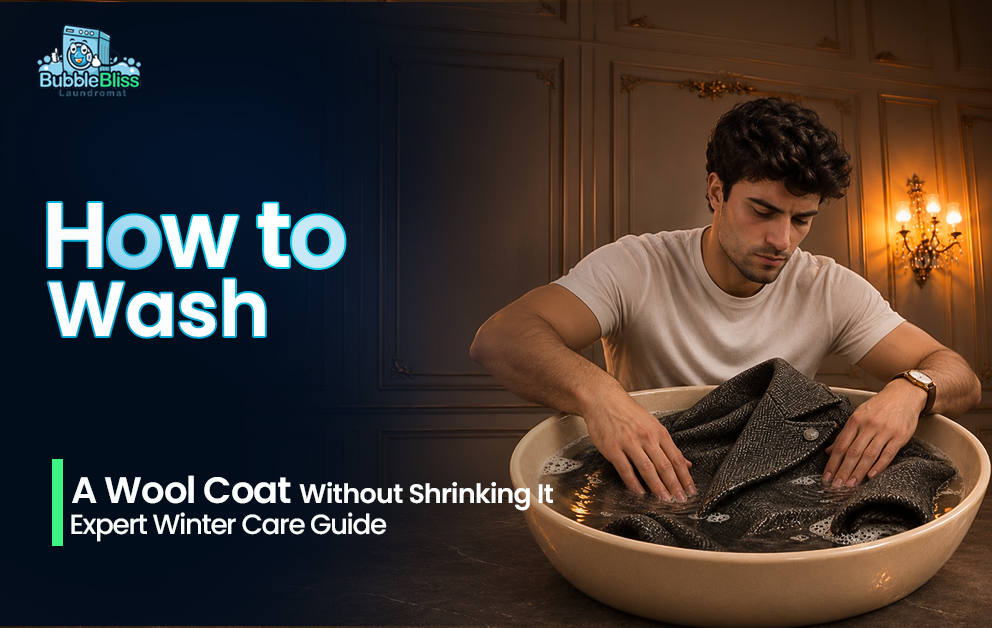
To wash a wool coat without shrinking it, check the care label first. If washing is permitted, use a compatible wool detergent, the recommended water temperature, and minimal agitation. Support the wet garment and dry it as directed. Structured or dry-clean-only wool coats generally require professional cleaning to protect their shape.
Learning how to wash a wool coat requires looking beyond the outer fabric. Unlike knitwear—covered in our guide on how to wash wool sweaters without shrinking—structured coats contain internal tailoring layers that respond differently to water. Even when the outer wool fiber is washable, internal components can warp or shrink unevenly.
Can You Wash a Wool Coat in a Washing Machine?
You can wash a wool coat in a washing machine only if the sewn-in care label explicitly permits machine washing. Under the Federal Trade Commission Care Labeling Rule, manufacturers must list at least one safe cleaning method.
- Machine Wash: Follow the exact cycle, temperature, and drying instructions on the tag.
- Hand Wash: Immerse gently by hand; do not substitute a standard machine cycle unless specified.
- Dry Clean Only: Never immerse the coat in water at home.
- Dry Clean (without “Only”): Consult a professional cleaner before attempting home water treatment.
Why Do Wool Coats Shrink? Understand Your Coat Before Washing
Wool coats shrink because wool fibers are made of keratin protein covered by overlapping microscopic scales called the wool cuticle. When moisture, heat, and mechanical agitation combine, these scales interlock and pull fibers tighter together in an irreversible process called felting shrinkage.
Coats can also experience relaxation shrinkage, which occurs when woven wool fabric releases tension created during textile manufacturing upon first exposure to moisture. More critically, tailored coats face differential shrinkage—where the outer woven wool shell, inner lining (such as viscose or acetate), coat interfacing (which stiffens collars and lapels), and shoulder padding shrink at different rates, causing permanent puckering and distortion.
| Coat type | Material or construction | Home washing eligibility | Primary cleaning risk |
| Pure wool overcoat | Dense woven wool, often lined | Only if care label explicitly permits | Felting shrinkage and lapel distortion |
| Unlined wool coat | Single-layer woven or boiled wool without internal padding | Potentially hand or machine washable if labeled | Overall shrinkage and seam puckering |
| Structured or fully lined wool coat | Wool shell with lining, interfacing, and shoulder padding | Usually not washable; typically dry clean only | Differential shrinkage and ruined tailoring |
| Wool-blend coat | Wool mixed with polyester, nylon, or other synthetic fibers | Follow complete garment care label | Uneven dimensional changes between layers |
| Cashmere-blend coat | Delicate animal hair blended with wool | Specialist assessment recommended | Surface matting, pilling, and texture loss |
| Machine-washable wool coat | Treated Superwash wool with water-compatible trims | Machine washable on approved wool cycle | Shrinkage or warping from incorrect settings |
Before washing any eligible coat, measure the sleeve length, shoulder width, and center-back length. You can track dimensional change using the formula:
S=L0–L1L0100
Where S is percentage shrinkage, L0 is the original measurement, and L1 is the measurement after cleaning and drying. For example, a coat measuring 100cm before washing and 97cm afterward experienced $3\%$ dimensional shrinkage. This calculation measures post-wash change; it cannot predict whether a coat will shrink.
How to Wash a Wool Coat at Home in 7 Safe Steps
Follow this seven-step protocol exclusively for coats whose care labels explicitly permit home washing.
| Step | Recommended action | Technical purpose |
| 1. Inspect | Read the complete care label and check linings, buttons, and trim. | Confirms whole-garment washability and identifies delicate trims. |
| 2. Prepare | Empty all pockets, fasten closures, and remove detachable belts or trims. | Prevents snagging, pocket sagging, and hardware abrasion. |
| 3. Brush | Gently brush the dry wool downward with a soft natural-bristle garment brush. | Lifts surface dust and grit before water sets debris into fibers. |
| 4. Assess stains | Inspect spots and apply only a wool-compatible pre-treatment if permitted. | Prevents setting localized stains without damaging protein fibers. |
| 5. Set bath | Fill a clean basin or machine with label-approved water temperature and wool detergent. | Protects keratin fibers from thermal shock and harsh alkalinity. |
| 6. Wash gently | Submerge and press gently by hand, or run the approved wool washing cycle. | Minimizes mechanical agitation to prevent fiber entanglement. |
| 7. Rinse & support | Rinse thoroughly at a consistent temperature and lift the coat from underneath. | Removes detergent residue while preventing wet weight from stretching shoulders. |
Choosing the Right Detergent for Wool Coats
Select a pH-neutral wool-safe detergent formulated without bleach or optical brighteners. Avoid standard heavy-duty laundry detergents containing protease enzymes, which are designed to break down protein stains but can weaken wool’s keratin protein structure under unsuitable washing conditions.
Hand Washing vs. Machine Washing
Hand washing gives you direct control over water movement, making it safer for loosely woven or unlined washable coats. Machine washing on a dedicated wool cycle offers consistent temperature control and gentle spin extraction, provided your machine has a certified wool setting and the garment label permits machine care. Neither method is safe for dry-clean-only outerwear.
How to Clean a Wool Coat Without Washing It
You can refresh a lightly worn wool coat between seasonal cleanings without full immersion:
- Brush after wear: Use a soft garment brush in downward strokes to remove subway dust, lint, and dried road salt contamination along the hem.
- Air properly: Hang the coat on a wide, contoured wooden hanger in a well-ventilated room for 24 hours to release trapped moisture and odors.
- Spot-treat cautiously: For fresh coffee spills or collar oils on washable fabrics, blot—never rub—with a clean, slightly damp cloth. Avoid applying water to structured lapels or dry-clean-only coats, as water rings and interfacing distortion can occur.
How to Dry a Wool Coat Without Shrinking or Stretching It
Never wring, twist, or hang a soaking-wet wool coat, as water weight pulls shoulders out of alignment. Press excess water out by rolling the coat inside clean, thick bath towels, then reshape the collar, lapels, and sleeves flat on a dry towel or mesh rack away from direct sunlight and steam radiator heat. Tumble dry only if the care label explicitly permits machine drying (The Woolmark Company).
| Processing stage | Estimated duration (illustrative) | Completion requirement |
| Garment inspection | 5–10 minutes | Care label and structural layers verified |
| Brushing and preparation | 5–10 minutes | Surface debris removed and pockets emptied |
| Compatible stain treatment | 5–15 minutes | Spots pre-treated according to fabric rules |
| Approved hand washing | 15–30 minutes | Gentle immersion and thorough rinsing finished |
| Approved machine washing | 30–60 minutes | Dedicated wool cycle completed |
| Supported water removal | 5–10 minutes | Excess moisture blotted with towels |
| Flat air drying | 24–72+ hours | Outer shell, lining, and padding completely dry |
| Professional cleaning and finishing | Confirm with provider | Cleaned, inspected, steamed, and pressed |
Note: Durations above are illustrative estimates for planning purposes and do not represent guaranteed turnaround times.
Can You Fix a Wool Coat That Has Shrunk?
Minor relaxation shrinkage or slight post-wash stiffness can sometimes be eased through gentle steam blocking and professional garment finishing. However, true felting shrinkage—where microscopic scales have fused tightly together—is permanent, and differential shrinkage between the shell and lining rarely reverses evenly.
Common Mistakes That Can Ruin a Wool Coat
- Washing dry-clean-only coats: Water warps internal interfacing and shoulder pads.
- Using aggressive agitation or wringing: Friction locks wool scales together permanently.
- Hanging a saturated coat: Heavy wet wool stretches lengthwise and ruins shoulder lines.
- Drying near steam radiators: Intense localized heat causes rapid shrinkage and scorches fibers.
- Trying unverified DIY stretches: Soaking felted wool in hair conditioner or vinegar and pulling forcefully often tears seams without restoring tailoring.
Frequently Asked Questions About Washing Wool Coats
1. Can you wash a wool coat in a washing machine?
You can machine wash a wool coat only if its garment care label explicitly permits machine washing. Use the recommended cycle, water temperature, and wool-compatible detergent. Structured coats with linings, shoulder padding, or interfacing generally require professional cleaning because internal components can warp even when the outer wool fabric appears washable.
2. Does washing a wool coat in cold water prevent shrinkage?
Cold water reduces heat-related shrinkage risks, but it does not guarantee a wool coat will keep its original size. Mechanical agitation in water can still cause wool cuticle scales to interlock and felt. Always check the care label, use a wool-safe detergent, minimize movement, and follow approved drying instructions.
3. Can you hand wash a wool coat?
Hand washing is suitable for wool coats whose care labels explicitly allow hand washing. Use the recommended water temperature and a compatible wool detergent, pressing the fabric gently without twisting or scrubbing. Avoid immersing structured or dry-clean-only coats, as internal linings, padding, and interfacing can distort permanently when saturated.
4. Can you wash a wool-blend coat at home?
Some wool-blend coats can be washed at home, depending on their fiber blend and internal construction. Even when blended with polyester or nylon, a coat with tailored interfacing or a delicate lining may require dry cleaning. Always follow the complete garment care label rather than relying on fiber percentages alone.
5. Can you put a wool coat in the dryer?
Only put a wool coat in the dryer if its care label explicitly permits tumble drying. Most wool coats require supported flat air drying to protect their tailoring and dimensional stability. Dryer heat and tumbling agitation significantly increase the risk of felting shrinkage, seam puckering, and structural damage.
6. How often should you clean a wool coat?
Clean a wool coat at the end of winter before storage and whenever visible stains, road salt, or persistent odors appear. Regular brushing and airing between wears extend the time needed between full cleanings. For structured coats, periodic professional care removes embedded body oils without risking water damage.
7. Can you restore a wool coat after it shrinks?
Minor dimensional distortion may sometimes improve with careful steam reshaping or professional garment finishing, but severe felting shrinkage is generally irreversible. Avoid forcefully stretching wet wool or relying on unverified household remedies. A professional cleaner can inspect whether the issue stems from felted wool, lining shrinkage, or warped interfacing.
Wool Coat Cleaning Tips for NYC Apartment Residents
Caring for heavy winter outerwear in New York City presents distinct practical hurdles. According to the NYC Rent Guidelines Board 2025 Housing Supply Report, approximately $68\%$ of NYC housing units are renter-occupied, and the city recorded a $1.41\%$ rental vacancy rate in 2024 alongside a $9.2\%$ rental overcrowding rate. Many apartments lack outdoor drying balconies or dedicated floor space to lay a heavy overcoat flat for up to three days.
Additionally, shared basement laundry rooms and local machines do not always offer calibrated wool cycles, and placing a damp coat near an apartment steam radiator risks severe heat shrinkage. For washable everyday garments that do not require dry cleaning—or if you want to check how to care for synthetic outerwear, see our guide on how to wash a puffer jacket safely (coming soon)—using specialized care for washable garments saves valuable living space.
How Much Does It Cost to Clean a Wool Coat in NYC?
Evaluating at-home washing against professional NYC garment care requires factoring in utilities, supplies, and risk:
Ctotal=Cwater+Cenergy+Cdetergent+Ctransport
Under the NYC Water Board FY 2027 Rate Schedule, effective July 1, 2026 (reflecting a $6\%$ rate increase), metered water is $\$5.35$ per 100cubicfeet (748gallons) and combined water and sewer charges equal $\$13.86$ per 748gallons. Using ENERGY STAR benchmarks—where a certified clothes washer uses about 14gallons per load versus 20gallons for a standard model—the water cost for a 14-gallon cycle is roughly $\$0.26$. Meanwhile, NYSERDA reported a New York State average residential electricity price of $\$0.284\text{ per kWh}$ in January 2026.
| Cleaning option | Cost in USD | Included services or limitations |
| At-home hand washing (water) | ~$\$0.09$ (illustrative 5gal) | Water/sewer only; excludes detergent, space, and risk |
| At-home machine washing (water) | ~$\$0.26$ (illustrative 14gal) | Water/sewer only; excludes electricity, detergent, and risk |
| Electricity & wool-safe detergent | Usage & product dependent | Varies by washer energy draw and specialty detergent cost |
| Published NYC cleaner example (Refresh Cleaner UWS) | $\$39.00$ (listed coat rate) | Third-party published price example; verify current terms |
| Published NYC cleaner example (Clean NYC) | From $\$72.00$ (listed starting rate) | Third-party published starting price; verify current terms |
| Bubble Bliss Organic Dry Cleaning | Request a personalized quote | Tailored to coat fabric, length, lining, and stain inspection |
| Bubble Bliss Valet Pickup & Delivery | Confirm at booking | Convenient door-to-door service for eligible orders |
Note: Competitor prices reflect published rates checked for market context and do not represent Bubble Bliss pricing or a citywide average.
When Should You Get a Wool Coat Professionally Dry Cleaned?
Choose solvent-based dry cleaning or specialized professional wet cleaning (a computer-controlled, minimal-moisture water process) whenever your coat is labeled “Dry Clean Only,” features structured shoulders and lapels, contains a delicate lining, or has oil-based stains and winter salt buildup. Professional cleaners inspect fabric composition, test stain compatibility, and use tensioned finishing equipment to preserve tailored proportions.
8. Is it better to wash or dry clean a wool coat?
The better choice depends on your coat’s care label, fiber content, and tailoring. Unstructured, washable wool coats can be safely washed at home with proper care, while lined, structured, or dry-clean-only coats are better suited for professional cleaning. A garment specialist can evaluate internal layers and stains to protect the coat’s fit.
Conclusion
Knowing how to wash a wool coat starts with respecting its construction, not just its fiber label. Always check care instructions first, minimize moisture and agitation on washable coats, dry flat away from radiators, and rely on professional care for tailored winter outerwear.
Protect Your Winter Wool Coats With Bubble Bliss Organic Dry Cleaning
Keep your favorite wool coats looking sharp throughout NYC’s winter season. Bubble Bliss Laundromat on the Upper West Side (224 W 104th Street, New York, NY 10025) offers professional organic dry cleaning in NYC alongside convenient NYC garment pickup and delivery for eligible garments. Visit our Upper West Side location or contact our garment-care team for a personalized cleaning quote.