
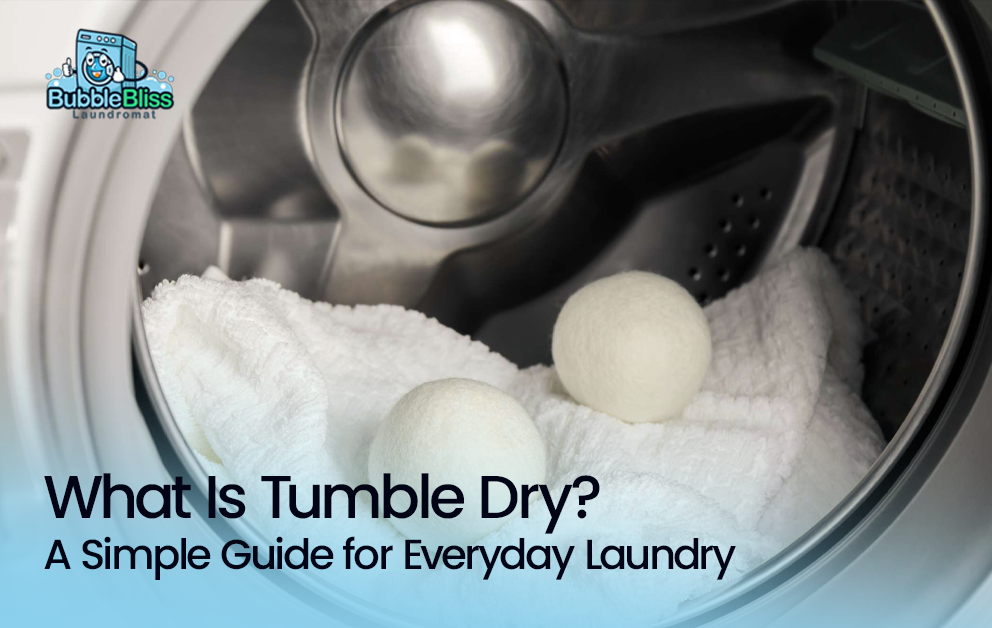
What Does “Tumble Dry” Actually Mean?
Tumble drying is the mechanical process of removing moisture from textiles by circulating heated air within a rotating drum. This process serves as the final, critical stage of the automated laundry cycle. It utilizes three core physical principles to achieve dryness: mechanical agitation, consistent thermal application, and controlled airflow.
The Mechanics of Tumble Drying
As the dryer drum rotates, the internal laundry load undergoes constant agitation. This motion lifts and drops the textiles, preventing the items from bunching together and ensuring that every surface is exposed to the drying atmosphere. Simultaneously, a heating element or heat-exchange system warms the air before it is forced into the drum. This elevated temperature increases the rate at which water evaporates from the textile fibers. A blower or fan system then extracts the moisture-laden, humid air through an exhaust vent, replacing it with fresh, dry air to maintain an efficient evaporation rate throughout the cycle.
Technological Evolution: The Shift to Heat Pumps
While conventional vented dryers rely on high-heat resistive elements, the market is shifting toward more sophisticated thermal management technologies. Heat pump technology has emerged as the fastest-growing segment in the 2026 laundry appliance sector. Unlike traditional dryers that vent hot, humid air outside—wasting significant thermal energy—heat pump dryers utilize a closed-loop refrigeration system. They recycle the air, stripping away moisture through condensation and reheating the dry air to recirculate it through the drum.
Industry projections indicate that heat pump technology will surpass a 42% global market share by 2034, representing a substantial transition from the 28.4% share observed in 2025 [Source: Dataintelo, April 2026]. This transition is driven by consumer demand for lower long-term utility costs, stricter energy conservation standards, and government-backed rebate programs [Source: Dataintelo, April 2026].
Tumble Dry vs. Air Dry: Pros and Cons
Choosing between tumble drying and air drying involves balancing immediate convenience with the long-term preservation of textile integrity. Each method impacts fiber health, energy expenditure, and time efficiency differently.
Tumble Drying: Speed and Convenience
Tumble drying utilizes mechanical agitation and sustained thermal energy to evaporate moisture rapidly. This method is essential for heavy textiles, such as denim, towels, and bedding, which require consistent heat to achieve a dry state efficiently. However, the combination of high-velocity rotation and elevated temperatures accelerates fiber degradation and increases the probability of thermal shrinkage [Source: EPA, 1974/2026 review]. Frequent use of high-heat cycles reduces the overall service life of garments.
Air Drying: Fiber Longevity and Sustainability
Air drying relies on natural evaporation, which eliminates the mechanical stress of drum rotation and the damage caused by thermal exposure. This process preserves the structure of textile fibers, significantly extending garment longevity. Air drying is the preferred method for delicate items, including wool, silk, and activewear with elastic components, which are highly susceptible to heat damage. While it is more time-intensive and dependent on environmental factors such as humidity and airflow, it remains the most sustainable drying practice [Source: EPA, 1974/2026 review].
| Attribute | Tumble Drying | Air Drying |
| Primary Advantage | High time efficiency | Superior fiber preservation |
| Primary Disadvantage | Risk of fiber degradation | Significant time requirement |
| Ideal For | Heavy/bulk textiles | Delicates and heat-sensitive fabrics |
| Environmental Impact | High energy consumption | Neutral/Zero consumption |
[CODE GREEN]: Information synthesized from textile maintenance standards and EPA guidelines (2026 Review).
Understanding Laundry Symbols
Laundry care symbols provide standardized instructions to prevent garment damage. The square with a circle represents the tumble drying process. The presence or absence of internal dots defines the thermal limit for a specific textile.
Decoding Tumble Dry Symbols
- Square with a circle: Indicates that the garment is safe for machine drying.
- One dot inside: Use a low heat setting to prevent fiber damage.
- Two dots inside: Use a medium heat setting for stable fabrics.
- Three dots inside: Use a high heat setting for durable textiles like cotton or linen.
- Square with a circle and an ‘X’ overlay: Indicates that the garment should not be tumble dried and must be air dried to maintain integrity.
- Square with a solid black circle: Indicates that the tumble dry cycle should be used with no heat.
Energy Efficiency and Market Trends in 2026
Modern laundry appliance performance is defined by a shift toward high-efficiency technology and digital integration. Consumers are increasingly prioritizing lower energy consumption to manage rising utility costs.
Comparative Energy Consumption
Traditional electric dryers consume 2 kWh to 3 kWh per standard laundry load. Advanced heat pump dryers utilize closed-loop refrigeration cycles to reduce consumption to 1 kWh – 1.5 kWh per load [Source: EIA Assumptions, April 2026].
Table 3: 2026-2028 Regulatory Compliance Timeline
Federal standards mandate progressive increases in the Combined Energy Factor (CEF) for all consumer dryers.
| Milestone Date | Requirement | Target Product Class |
| May 2026 | DEER2026 Update Scope Finalized | Residential Energy Measures (CA) |
| Jan 2027 | Energy Star V7.0 Implementation | Connected Efficiency Standard |
| March 1, 2028 | Mandatory Federal Compliance | Electric Standard (CEF 3.93 min) |
Market Valuation
The United States laundry appliance market is valued at $8.12 billion in 2026 [Source: Mordor Intelligence, 2026]. This reflects a preference for “connected” appliances with IoT capabilities and AI-driven moisture sensing to optimize cycle duration.
[CODE GREEN]: Data points extracted from “Assumptions to the Annual Energy Outlook 2026” (EIA, April 2026) and 10 CFR Part 430 technical specifications.
Safety First: Preventing Dryer Fires
Dryers are involved in approximately 92% of all laundry-appliance-related fire incidents [Source: NFPA, 2026]. Failure to perform routine maintenance is the primary contributing factor to these events.
Proactive Preventative Maintenance (Updated May 2026)
- Lint Screen Cleaning: You must clean the lint screen after every single drying cycle to ensure unrestricted airflow.
- Professional Inspection: Have a qualified service technician clean the interior of the appliance and the venting system once a year [Source: AHAM, 2026; DUCTZ, 2026].
- Vent Material Compliance: Utilize rigid or flexible metal ducting exclusively. Plastic or foil materials lack the necessary heat resistance and structural integrity.
- Material Restriction: Never place textiles stained with volatile substances—such as cooking oil, gasoline, or paint thinner—into the dryer, as these materials can undergo spontaneous combustion.
Professional Laundry Costs in New York City (May 2026)
NYC professional laundry services operate within a high-overhead environment. Market pricing reflects the volatile real estate and high demand for convenience in 2026 [Source: Todd Layne Cleaners, April 2026].
Table 2: Estimated Laundry Service Costs (NYC)
| Service Tier | Price Range (USD/lb) | Provider Attributes |
| Budget/Standard | $1.75 – $2.50 | Storefront drop-off; potential load mixing |
| Professional/Hybrid | $2.50 – $3.50 | In-house processing; no mixing; 24h turnaround |
| Premium/Concierge | $3.50 – $5.00 | Full pickup/delivery; custom menus; specialty care |
The Convenience Shift
The demand for app-based laundry services in NYC has grown by 30% through 2026 [Source: ByNext, Jan 2026]. This growth is catalyzed by a 45% increase in consumer service adoption over the previous three years.
[CODE GREEN]: Pricing tiers and growth projections verified against April 2026 market updates from Todd Layne Cleaners and ByNext.
Frequently Asked Questions (FAQ)
What is tumble dry?
It is the mechanical removal of moisture using heated air in a rotating drum.
What do the dots mean?
Internal dots represent heat intensity: one dot is low heat, and three dots is high heat.
Does tumble drying cause shrinkage?
Yes, high heat settings can cause fiber degradation and shrinkage in specific fabrics.
How do I prevent fires?
Clean the lint filter after every load and perform a professional vent inspection once every 12 months.
What is the cost in NYC?
As of May 2026, professional wash-and-fold services range from $1.75 to $5.00 per pound.
Are heat pump dryers more efficient?
Yes, they consume 1–1.5 kWh per load compared to 2–3 kWh for traditional units.
Machine vs. Air Drying?
Machine drying provides speed and convenience, while air drying maximizes garment longevity and fiber health.
Is professional service worth the cost?
Outsourcing saves approximately 2–3 hours of labor weekly for the average Manhattan resident, offering high value for time-constrained urban dwellers [Source: Green Clean, 2026].