
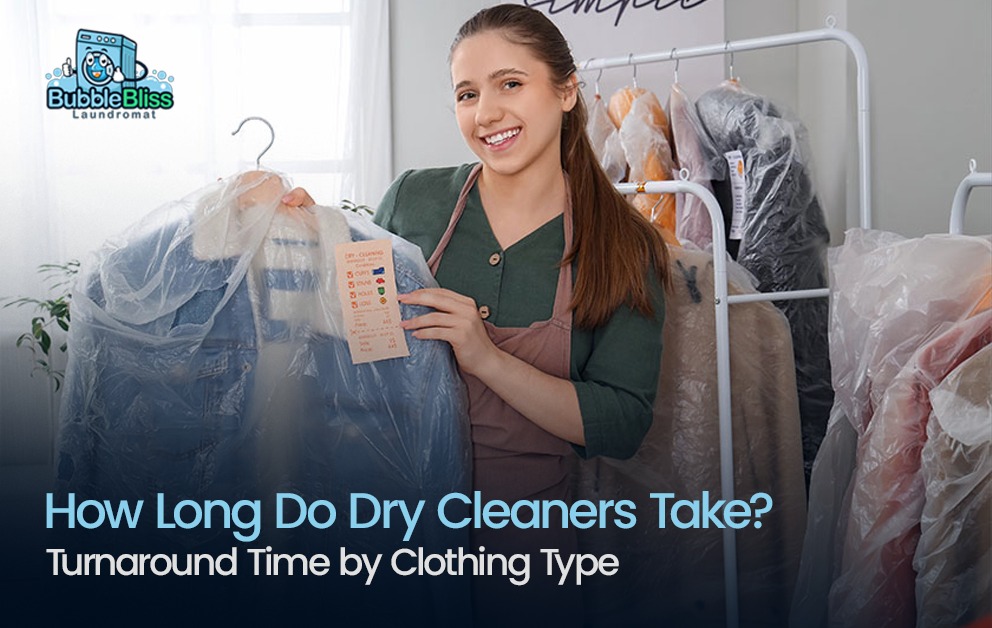
How long do dry cleaners take to return processed garments? The standard average dry cleaning turnaround time has optimized down to 24 to 48 business hours. This baseline speed depends on modern centralized continuous-flow plants. On-premises operations execute express drop-offs in under 12 hours.
Professional textile care requires a calculated equilibrium of chemical solvent thermodynamics, plant logistics, and structural fabric mechanics. The process does not resemble simple home appliance laundering. Technicians isolate individual garments based on fiber construction. Oily soils dissolve during localized chemical wash cycles. Drying phases require precise automated temperature regulation to prevent structural fiber shrinkage. Mass sorting queues introduce predictable logistical wait times before physical machine loading.
The Quick Reference Timeline (Key Facts at a Glance)
Professional dry cleaning turnaround time matrices derive variables from physical textile material structures instead of simple dimensional garment size. Intricate structural construction layers determine the total duration required for safe extraction processing. For example, customized suit jackets contain internal horsehair canvases that collapse under aggressive mechanical force. Alternative solvent extraction dynamics dictate additional duration criteria because eco-hydrocarbon and silicone solutions feature lower volatility profiles than traditional perchloroethylene.
These gentle chemicals demand extended mechanical run cycles alongside low-temperature drying parameters to completely clear fluid weight from complex fiber matrices without triggering fiber degradation.
| Garment Profile Class | Baseline Turnaround | Express Capability | Primary Structural Risk |
| Standard Basics (Shirts, Blouses) | 24 Hours | Yes (Same Day) | Button crackage / Collar wrinkling |
| Customized Formals (Suits, Blazers) | 48 Hours | Yes (Next Day) | Canvas distortion / Lapel bubbling |
| Outerwear & Heavy Fabrics (Coats) | 3–5 Days | Rare (Case-by-case) | Lining shrinkage / Internal moisture retention |
| Delicate & Embellished (Silks, Gowns) | 1–2 Weeks | No | Bead melting / Seam fraying / Dye bleeding |
Detailed Turnaround Breakdown by Clothing Type
The throughput velocity of a professional dry cleaning plant is determined by a complex interaction of physical garment attributes. Operational efficiency does not scale linearly with item volume; rather, it is dictated by the structural architecture of the garments, the density of the fabric, specific moisture-retention capacities, and the solvent extraction requirements mandated by chemical safety standards. Understanding these variables explains why specialized items require extended processing windows to maintain structural integrity and prevent irreparable fiber damage.
Everyday Wardrobe: Dress Shirts, Blouses, & Casual Slacks
Standard woven dress shirts, blouses, and casual slacks typically follow a 24-hour turnaround cycle. These garments are generally constructed from high-throughput fabrics such as cotton, polyester, or standard poly-cotton blends. Professional plants leverage automated high-velocity shirt-tensioning blowers and specialized utility sleek-press machinery to rapidly expedite drying and finishing lines.
Because these garments feature un-layered, flat surface construction profiles, they avoid structural cooling bottlenecks often found in multi-layered attire. This architectural simplicity allows them to move through mechanical staging sequences rapidly without incurring dimensional distortion risks, enabling efficient, high-volume processing in a single business day.
Professional Attire: Two-Piece Suits, Blazers, & Pleated Trousers
Professional corporate attire necessitates a strict 48-hour cycle to ensure quality control. The extended timeframe is required by complex internal fabric mechanics; tailored suit jackets incorporate structural elements such as shoulder padding inserts, internal horsehair fusible canvases, and hanging wool linings. These components absorb steam and chemical solvents differentially compared to the outer shell fabric.
Following the pressing process, these interconnected layers must remain on hangers to completely cool down and stabilize naturally. This stabilization phase is mandatory to prevent localized bubbling, canvas warping, or lapel distortion.
Outerwear & Insulated Items: Heavy Overcoats, Leather, & Suede Jackets
Heavy outerwear, including wool overcoats, tweed jackets, and down-insulated items, requires a 3-to-5 business day window. Dense insulating materials trap solvent, necessitating longer, carefully calibrated mechanical agitation and drying cycles to ensure complete evaporation.
Specialized leather and suede items require a stricter 7-to-10 business day window.
Cleaning these animal skins involves more than surface treatment; professional cleaners must perform post-extraction specialized conditioning. This process involves the manual re-injection of premium oils back into the hide to replace natural fats lost during solvent cleaning. Without this critical re-oiling step, leather surfaces undergo cellular desiccation, leading to hardening, grain cracking, and permanent structural degradation.
Furthermore, large household comforters require up to 7 business days to facilitate total core ambient drying, preventing internal mold development caused by retained moisture in heavy fillings.
High-Value Specialties: Formal Evening Gowns & Wedding Dresses
Luxury formal apparel and wedding gowns mandate a 1-to-2 week timeline. The processing of these high-value items involves non-negotiable operational checkpoints focused on preservation rather than throughput speed. Technicians perform exhaustive micro-precision manual hand-spotting on localized tannin or protein matrices to avoid damaging fragile fibers.
Cleaners utilize custom protective mesh wrapping to isolate delicate surface embellishments such as glass beading, sequins, and lace fringes, from mechanical friction. The final phase involves multi-stage extended ambient inspection steps conducted under calibrated, high-output lighting rigs. These inspections verify complete soil elimination before any heat-setting configurations are applied, ensuring the gown retains its original luster and structural configuration without risking thermal damage to delicate adhesives or synthetic trims.
Step-by-Step: Behind the Scenes of the Dry Cleaning Processing Line
The total dry conditioning process time depends on administrative logistical queues. Garments complete machine solvent immersion loops in less than one hour. Textiles spend the vast majority of the overall timeline waiting inside staging lines. Sorting protocols introduce significant logistical holding intervals. Manual pre-spotting stations create mandatory processing wait times. Post-wash form finishing departments require extensive manual execution periods.
- Inspection Sorting Protocol: Garment processing steps begin at the sorting station. Technicians affix a heat-resistant matrix barcode to each item. This tracking system prevents order mix-ups. The digital system logs specific customer instructions. Employees sort garments into distinct batches based on fabric weight. Batching parameters isolate identical color spectrums. Separating white textiles avoids dye redeposition during the wash cycle. Batches are segregated by chemical solvent compatibility. This sorting protocol protects fragile pieces from mechanical compression. Compatible cycles prevent fiber damage from incorrect fluid exposure.
- Pre-Spotting Chemical Engineering: Garments move into the pre-treatment queue. Master spotters examine each garment on a specialized stain board. High-intensity localized lighting reveals hidden soils. Spotters select targeted chemical agents based on soil origin. Protein digesters dissolve organic matter. Tannin digesters break down plant-based residues. Technicians manually tamp the spot with a specialized brush. Mechanical tamping forces the chemical solution deep into the fiber matrix. The spotting station utilizes steam guns to flush out dissolved soils. Pre-spotting must occur before machine loading. Machine heat sets untreated chemical stains permanently.
- The Mechanical Solvent Wash Cycle: Sorted garments enter a sealed machine drum. Modern industrial plants utilize closed-loop architectures. Traditional perchloroethylene wash cycles complete in 15 minutes. Perchloroethylene features aggressive solvency dynamics. Alternative hydrocarbon eco-solvents require 22 to 30 minutes of runtime. Hydrocarbon fluids possess a lower chemical solvency power. Eco-solvents exhibit slower evaporation rates. Drying sensors continuously monitor drum solvent vapor concentrations. Centrifugal force removes fluid weight during the mechanical extraction phase. Cool-down loops stabilize garment temperatures before mechanical unloading.
- Post-Spotting Quality Inspection Auditing: Unloaded garments enter the post-wash inspection queue. Inspectors examine textiles under calibrated high-output lighting rigs. Cross-examination protocols verify the complete elimination of soils. Technicians look specifically for faint chemical shadows. The auditing process checks for leftover soil halos. Persistent spots undergo manual secondary treatment cycles. Post-spotting prevents permanent setting of recalcitrant residues. Garments with remaining soils return to the spotting board. Approved items proceed to the finishing line.
- Form-Pressing Structural Finishing: Textiles undergo structural finishing inside specialized hands-on lines. The finishing process avoids basic flat surface ironing. Operators place garments on specialized vertical tension equipment. Steam injection relaxes compressed textile fibers. Utility press machines reform structured fabric geometric panels. Technicians meticulously hand-press delicate structural components. Finishing processes align complex internal garment linings. Natural cooling stabilizes the outer shell textile. The structural press restores original crisp fabric creasing. Finishing procedures re-establish original garment silhouettes.
- Final Inspection Assembly Packaging: Finished garments proceed to the automated assembly line. Computerized tracking scanners read individual matrix barcodes. The distribution system matches single items to their parent order. Automated conveyors sort completed packages by destination route. Staging queues group orders into localized delivery zones. Packaging lines utilize custom breathable materials. Breathable wraps prevent mold-inducing moisture retention. Protective coverings shield fabrics from ambient light exposure. Proper packaging eliminates immediate storage yellowing risks. Cleaned garments hang ready for immediate wardrobe integration.
Primary Variables That Can Extend Your Pickup Window
What primary variables extend your garment pickup window? Standard delivery projections represent optimized facility states. Real-world operational constraints regularly disrupt these baseline schedules. Chemical soil complexities introduce unexpected plant bottlenecks. Alternative solvent crystallization rates dictate extended machine run times. Logistical plant routing configurations create external delivery transit delays. These combined mechanical factors naturally pad baseline consumer wait times.
Stain severity represents a critical stain removal delay factors anchor. Old grease soils polymerize under standard finishing lines temperature elevations. This chemical transformation permanently binds pigment particles to fabric fibers. Master spotters must execute multiple chemical soaking sequences to reverse the bonding. Technicians perform manual tamping cycles on specialized structural spotting boards. These repetitive manual treatments extend overall garment processing timelines. Deep-set organic blood matrices require extensive ambient curing phases. Deep-set wine matrices demand supplementary chemical flushing loops.
Solvent selection directly impacts perchloroethylene vs hydrocarbon cycle times. Perchloroethylene features an aggressive chemical solvency power profile. Standard perchloroethylene wash runs complete within fifteen minutes. Modern high-flash hydrocarbon alternatives possess lower chemical volatility characteristics. These eco-solvents require minimum wash runs of 25 minutes. Hydrocarbon solutions demand higher drying threshold periods to clear fluid weight completely. Extended mechanical extraction steps add up to 24 hours to high-volume plant queues.
Plant architecture introduces administrative logistical holding intervals. On-site retail facilities process items directly inside the storefront counter machine. Outsourced processing hub models rely on fixed truck transport routing loops. Centralized loading plants require complex mechanical sorting protocols. These multi-tier commercial sorting operations produce dead-transit hub lag intervals. Decentralized systems add 24 to 48 business hours to standard processing windows.
Seasonal customer demand patterns alter baseline facility throughput capabilities. Holiday periods cause immediate garment volume saturation across physical press lines. Wedding peak seasons create operational backlogs inside multi-point quality control assembly queues. High sorting volumes increase order tracking validation queues. Cleaners prioritize fragile bridal gowns over everyday basics. These seasonal bottlenecks extend pickup projections by several business days.
Turnaround Timeline Variations by Factor Matrix
| Critical Variable | Low Impact Window | High Impact Window | Operational Delay Root Cause |
| Stain Severity | 1–2 Days (Light surface dust) | 3–7 Days (Deep-set oil, wine, blood) | Multiple chemical soaking, structural board tamping, and ambient curing cycles
$$Source: BerryC / DLI$$ |
| Solvent Selection | 24 Hours (Perchloroethylene) | 48 Hours (Eco-Hydrocarbon) | Less aggressive solvency power extending wash runs to 25+ minutes alongside prolonged extraction/drying requirements
$$Source: MassDEP / CINET$$ |
| Plant Architecture | 24 Hours (On-Site Processing) | 48–72 Hours (Outsourced Hub Transit) | Fixed truck transport routing loops, centralized loading sorting, and dead-transit hub lag intervals
$$Source: SlideTeam / CloudLaundry$$ |
| Seasonal Demand | 24–48 Hours (Standard Baseline) | 3–5 Days (Holiday & Wedding Peaks) | Volume saturation across physical press lines and multi-point quality control assembly queues
$$Source: Nimble Made / Rinse$$ |
The Financial Blueprint: Dry Cleaning Cost Analysis (US vs Global Parity)
How much do dry cleaners charge for professional garment care in US? Average retail pricing ranges from $4.50 to $7.50 for standard dress shirts. Two-piece business suits cost from $18.00 to $28.00. Heavy outerwear items require expenditures from $25.00 to $45.00. Formal evening gowns scale from $35.00 to $75.00. Basic wedding dress preservation pricing spans from $150.00 to $350.00.
Local price variations across municipal neighborhoods reflect physical commercial operational constraints. On-site retail processing plants incur high localized property lease overheads. Centralized hub collection spaces isolate manufacturing operations to remote low-cost zones. Storefront boutique retail spaces pass tracking logistics costs to consumers. Global business professionals analyze these geographic pricing differentials to select authorized dry cleaners. International students evaluate local currency exchange benchmarks to stabilize educational stipends. Expats monitor multi-region service fee variations to balance corporate relocation funds.
Currency parities map local rates at a stable benchmark of 1 USD to 0.80 GBP. High-end specialty finishing facilities inside Manhattan introduce distinct priority processing surcharges. Intricate garment surface trims trigger manual natural fiber isolation premiums. Urgent throughput priority requirements attract express rush scheduling fees. Localized premium rush fees range from an additional $50.00 to $400.00 per processed item.
Cost Comparison Matrix (USD & GBP Parity)
| Garment Type | Average Cost (USD – Local NYC) | Equivalent Cost (GBP – Global Parity) | Extended Turnaround Surcharge Tier |
| Standard Dress Shirt | $4.50 – $7.50 | £3.60 – £6.00 | None (Standard Processing) |
| Two-Piece Business Suit | $18.00 – $28.00 | £14.40 – £22.40 | +25% for Same-Day Rush Processing |
| Heavy Outerwear / Coat | $25.00 – $45.00 | £20.00 – £36.00 | +30% for Delicate Lining Treatment |
| Formal Gown / Evening | $35.00 – $75.00 | £28.00 – £60.00 | Evaluated on Embellishment Count |
| Wedding Dress (Basic) | $150.00 – $350.00 | £120.00 – £280.00 | Variable Tier (Preservation Boxing) |
Note: Exchange rate conversions reflect a stable benchmark of 1 USD to 0.80 GBP. Local NYC prices fluctuate based on specific material requirements. High-end finishing structures inside Manhattan attract specialty delicate fabric surcharges. Premium rush processing costs range from $50.00 to $400.00. Surcharges depend on automated throughput priority scheduling parameters. Specialized items require extensive manual fiber isolation protocols.
Optimization Tactics: How to Secure Same-Day Service in NYC
How do clients secure same day dry cleaning from dry cleaners nyc? Bubble Bliss Laundromat executes an express turnaround window of 8 to 12 hours. This expedited timeline demands strict customer adherence to morning drop-off schedules. Garments must clear initial physical scanning checkpoints before specific non-negotiable facility cutoff markers to satisfy automated manufacturing constraints.
Expedited processing velocity depends entirely on fixed facility batching cycles. Technicians sort incoming textiles by material weight inside localized fabric sorting stations. Garments move systematically into separate closed-loop chemical cleaning lines. Finishing teams prioritize express items inside specialized steam pressing queues. Fulfilling these synchronized production phases requires optimized drop-off windows.
The Hard Morning Cutoff
New York professionals must observe the hard morning cutoff protocol. Garments must pass physical scanning at the intake desk before 9:00 AM EST. Late arrivals automatically miss the morning continuous-flow plant run. Missing this time marker delays order completion by 24 business hours. Bubble Bliss Laundromat enforces this deadline to protect automated plant scheduling.
Garment Selection Rules
Expedited same-day processing requires strict adherence to garment selection rules. Customers must limit rush requests exclusively to standard everyday basics. Woven cotton dress shirts clear high-velocity tensioning equipment rapidly. Synthetic blouses qualify for accelerated low-temperature machine sorting cycles. Simple casual slacks process through utility pressing lines without dimensional risk. Complex corporate garments do not qualify for expedited runs. Structured wool two-piece suits require 48 business hours of plant processing. Lined outerwear garments demand extended multi-layer stabilization intervals. These dense assemblies must cool naturally post-pressing to prevent localized canvas bubbling.
Pre-Sorting Efficiency Rule
The best dry cleaners in NYC utilize a pre-sorting efficiency rule to maintain maximum hourly throughput. Urban professionals must empty all garment pockets completely at home. Leftover ink pens cause severe dye redeposition damage inside closed machine drums. Forgotten cosmetic tubes trigger major fabric staining risks during thermal extraction phases. Clients must pre-separate standard everyday garments from fragile textiles. Isolating fine silks eliminates counter triage delays. Separating heavily stained clothing allows technicians to initiate immediate manual chemical tamping boards. Pre-sorting ensures garments clear assembly lines without missing critical quality cues.
Frequently Asked Questions (FAQ Section)
Q1: What is the fastest a dry cleaner can clean a garment?
Under optimal conditions, an on-site dry cleaning plant can complete a standard garment cycle within 3 to 4 hours. However, ensuring premium quality control and flawless hand-pressing means that most professional locations request a reliable same-day window of 8 to 12 hours.
Q2: Why does leather dry cleaning take over a week?
Leather cannot be processed using standard dry cleaning machinery or basic solvents, as these strip away essential natural oils. It requires delicate, specialized fluids, gentle slow-cycle extraction, and a dedicated re-conditioning phase to restore its original texture, flexibility, and protective outer barrier.
Q3: Does bringing in clothes early guarantee same-day turnaround?
Dropping off items early significantly improves your chances, but eligibility ultimately depends on fabric type and current volume. Standard items like cotton dress shirts or basic slacks submitted before 9:00 AM EST qualify for same-day return, whereas complex wool suits or heavily stained garments will require an extended processing window.
Q4: How long do dry cleaners hold onto your clothes after cleaning?
Most urban dry cleaning operations hold completed orders for 30 to 60 days before applying storage surcharges. Under local consumer protection regulations, abandoned items are securely held for up to six months, after which they may be donated or responsibly recycled.
Q5: Can old, deep-set stains extend the turnaround time?
Yes. Deeply set or aged stains require multiple targeted spotting sessions and gentle ambient air-curing cycles between chemical treatments. Rushing this detailed process can permanently damage delicate fabric fibers or leave ghosting residue on high-value garments.
Q6: Why do comforters and bedding take longer than standard clothing?
Large bedding items require oversized, high-capacity drum machinery to allow deep solvent penetration and adequate rinse extraction. Their heavy composition requires extended, low-temperature drying phases to guarantee that the core filling is entirely moisture-free, preventing mold development.
Q7: Is next-day service available for delicate fabrics like 100% silk?
Next-day service for delicate silk items is rarely recommended. Silk fibers are highly susceptible to friction damage and dye bleeding, meaning they require slower mechanical cycles, gentle manual hand-spotting, and precise iron finishing temperatures that cannot be rushed without sacrificing quality.
Q8: How does the choice of solvent affect pickup schedules?
Modern hydrocarbon or silicone-based eco-solvents have a lower volatility profile than traditional perchloroethylene. This requires longer chemical wash cycles and extended drying times to evaporate completely, which can add up to 12 to 24 hours to high-volume processing queues.